
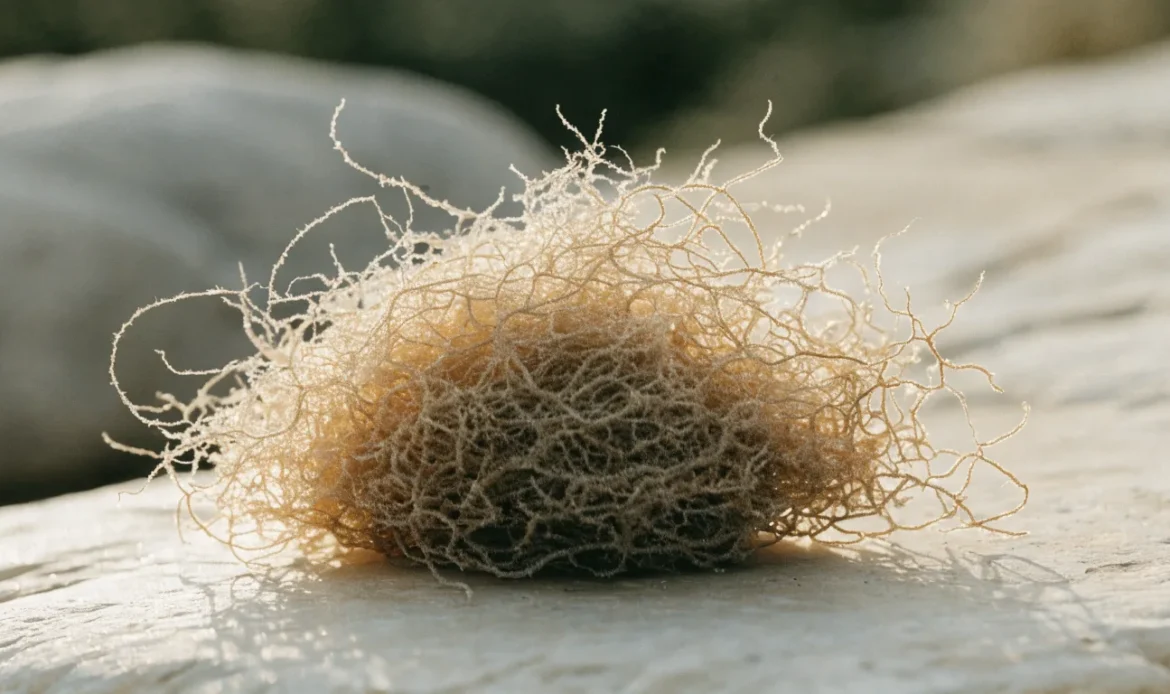
Short answer: Golden sea moss is a form of red algae (commonly called “sea moss”) that shows a pale yellow to gold color. Color comes from the species, the water and light where it grew, and how it was handled and dried. If you want to buy or source golden sea moss, check species names, harvest method (wild or farmed), and lab testing for iodine and contaminants.
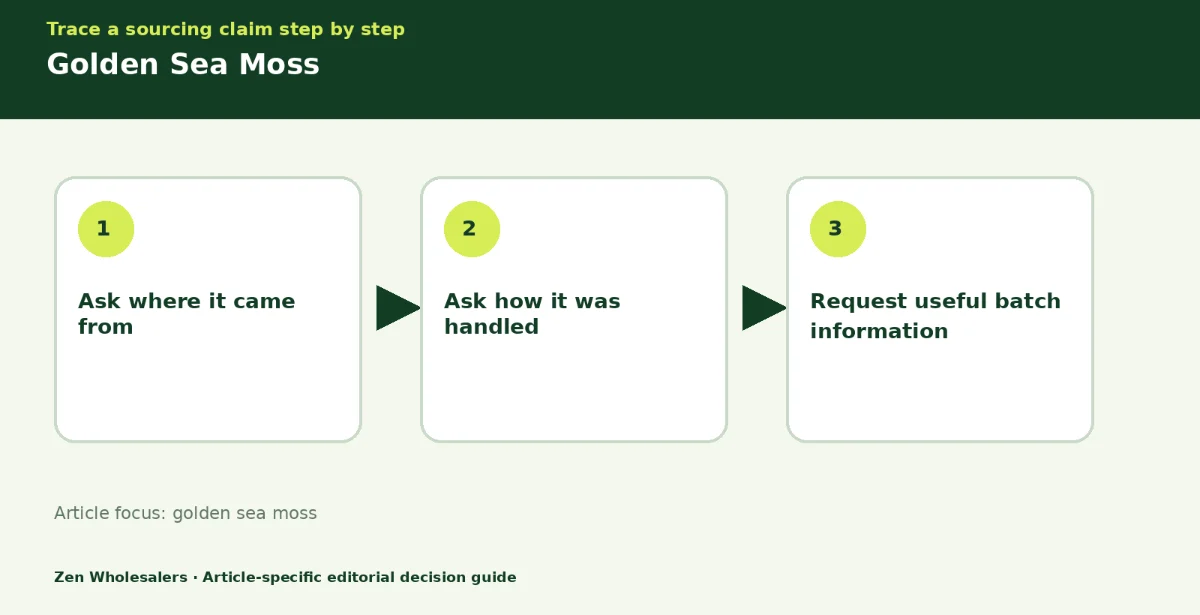
This guide focuses on sourcing and origin. It tells you what you can check. It also explains what supplier documents can and cannot prove. Use the checklist here to ask the right questions of any seller.
What is golden sea moss?
- Golden sea moss is not a single species name. “Golden” describes color.
- Sea moss refers to several kinds of edible marine algae in the red algae group. Color can vary from deep red to green to yellow-gold.
- Color may come from natural pigments in the plant, the amount of sun it received, minerals in the water, or the way it was dried.
- Different species and growing conditions make color changeable. The same species can look different in different places or seasons.
Note: Scientific names and clear photos help identify what you are buying. Good sellers will tell you the species they sell.
Sources: Seaweed overviews explain that different algae contain different pigments and nutrients. See References [1].
Where does golden sea moss come from?
Golden sea moss can be wild-harvested or farmed. Both routes exist. Common steps in the supply chain are:
- Growth in the sea (wild or farmed).
- Harvesting by hand or with gear.
- Rinse on site to remove sand and debris.
- Drying (sun-dry or mechanical dry).
- Packing and shipping.
What to check about origin:
- Is the product wildcrafted or farmed?
- Which coastal region or general area was it harvested from?
- When was it harvested?
- Was it rinsed and dried promptly?
Why this matters:
- Water quality, tides, and local conditions shape the algae’s composition and color.
- The same product name can mean different things depending on region and season.
What sellers should provide:
- Species name (Latin name if possible).
- Whether it is wild or farmed.
- Harvest date or season.
- Photos of the raw material and the harvesting process.
Avoid sellers who refuse simple questions about where and how their product was harvested.
How color forms in sea moss
- Pigments: Seaweeds contain pigments like carotenoids and chlorophyll. These affect color.
- Environment: Light, water depth, and minerals can change pigment balance.
- Drying: Sun drying can bleach or mellow color. Mechanical drying may retain more color.
- Age and season: Younger fronds and seasonal growth phases often look different.
Color alone does not prove quality. It is one visible trait. Use color as a clue, not the whole picture.
References: General seaweed information on pigments and variability can be found in [1].
What you can check about origin and sourcing
Below is a practical checklist to use with any seller. Ask for these items before you buy, especially for large or wholesale orders.
| Ask the seller for: | Why it matters | What to look for |
|---|---|---|
| Species/Latin name | Identifies the algae type | Clear species name, not just marketing color name |
| Wild or farmed | Different risks and traceability | Honest answer; many farms use ropes and nets; wild harvests are hand-picked |
| General harvest region (coast name or area) | Helps assess likely water conditions | A broad region is OK; be wary of vague answers like “from the tropics” |
| Harvest date or season | Freshness and batch tracking | Recent harvest date or clear season; older stock should be labeled |
| Photos of harvest and raw material | Confirms handling and appearance | Clear photos of seaweed in water and laid out to dry |
| Drying method (sun, low-heat, mechanical) | Affects color and microbes | Honest description; low-heat mechanical drying is common for consistency |
| Lab testing / Certificate of Analysis (COA) | Checks for iodine and contaminants | COA from an accredited lab showing tested parameters and date |
| Tests included on COA | Know what was measured | Iodine, heavy metals, microbial limits are common and useful |
| Batch number or lot code | Allows traceability | Useful for reorders and recalls |
| Sample or small trial | Try before buying bulk | Request a small sample to inspect color and smell |
| Packaging and storage instructions | Affects shelf condition | Clear guidance on storage and shelf handling |
This table helps you ask focused questions. Keep written records of answers.
Lab testing: what to ask for and why
Tests you might request on a COA:
- Iodine level. Seaweeds can contain variable iodine. Ask for measurement if you need that info. The iodine content of seaweed can be highly variable; this is documented in reviews and surveys [2], [3], [5].
- Heavy metals (lead, cadmium, arsenic, mercury). Testing helps show whether levels meet local food standards. Surveys show testing is done in regulatory programs [3].
- Microbial tests (total plate count, yeast and mold, E. coli, Salmonella) if the product is sold as food.
- Tests for other contaminants if relevant (e.g., pesticide residues) — only if the seller has reason to suspect them.
- Date of the test and lab accreditation. Look for an accredited third-party lab.
What a COA can do:
- Show measured levels for the tested batch.
- Help you compare batches or suppliers.
What a COA cannot do:
- Guarantee all future batches will match the COA.
- Prove a seller’s entire supply chain if the COA covers only one lot.
- Replace clear labeling and traceability.
References: Health literature and regulatory surveys discuss iodine variability and the need for monitoring in seaweed products [1], [2], [3], [5]. Guidance on dietary supplement claims and product types is summarized in [4].
What sellers can show and what they cannot prove
What they can reasonably show:
- Photos of the product and harvest.
- A COA tied to a specific lot.
- Shipping and batch information.
- A description of harvesting and drying methods.
What they cannot prove with photos or single COAs:
- Long-term safety of all batches without ongoing testing.
- That an entire product line is identical across seasons or regions.
- That color guarantees a particular nutritional profile.
If a seller makes strong claims about health or nutrient levels, ask for measured data and the lab method used. Be wary of sellers who make medical claims. We do not recommend relying on marketing words alone.
A practical decision guide for buyers
Use this short flow to decide whether to buy a supplier’s golden sea moss.
- Is the seller transparent about species and source?
- No → Ask for details or consider another supplier.
- Yes → Go to step 2.
- Does the seller provide a recent COA from an accredited lab for iodine and heavy metals?
- No → Ask for testing or a sample. Avoid large purchases until you have a COA.
- Yes → Go to step 3.
- Do photos and batch info match the COA and your expectations?
- No → Ask for additional documentation or samples.
- Yes → Consider a trial order.
- Are you buying wholesale?
- Yes → Request ongoing batch traceability, a supplier quality agreement, and regular COAs.
- No → A single batch COA and sample may be sufficient.
This flow is a guide. Adjust it to your risk tolerance and local rules. For wholesale orders, require stricter traceability and testing.
Tips for evaluating photos and samples
- Look for consistent color and texture across multiple photos.
- Check for signs of sand or foreign matter.
- Smell the sample. Fresh sea moss should smell mildly oceanic, not rotten.
- Rehydrate a small sample to check texture.
- If drying method is unclear, ask whether drying was done soon after harvest.
Photos and samples are useful. They are not guarantees.
Storage and basic handling
- Store dried sea moss in a cool, dry place away from direct sunlight.
- Keep sealed in a container or bag to limit moisture uptake.
- If you receive wet or jarred sea moss, follow the seller’s storage instructions.
- Use the batch number on the package for any future questions.
Do not assume shelf life from appearance alone. Ask the seller for storage guidance.
Next steps and links
If you want to read more about seaweed in general, start with our learning hub on sourcing and seaweed basics: /learn/
Looking for products or a small sample? Browse our store: /shop/
Interested in larger orders or partner pricing? See our wholesale information: /wholesale/
Have a specific question or need COAs and batch photos? Contact us: /contact/
Return to our home page for company info: /
Conclusion
Golden sea moss is a color description within the broader group of edible seaweeds. Color alone does not tell the whole story. To source responsibly, ask for species information, harvest details, clear photos, and recent lab testing. A COA from an accredited lab and a clear batch number are especially useful when buying larger quantities. Use the checklist and decision guide in this article to ask precise questions. If a seller cannot answer these basics, consider another source.
Continue reading
Frequently asked questions
Is golden sea moss a different species from other sea moss?
Not necessarily. “Golden” usually refers to color, not a single species. Ask the seller for the species or Latin name if you need precise identification.
Does color tell me about safety?
Color alone does not prove safety. Color can hint at species or drying method, but lab testing is needed to evaluate contaminants and iodine levels.
Should I worry about iodine in sea moss?
Seaweeds can contain iodine and its levels vary widely. If iodine content matters to you, ask for a measured iodine result on a COA. Reviews and surveys note that iodine varies across seaweed products [2], [3], [5].
What is a COA and why ask for one?
A COA is a certificate of analysis. It shows lab measurements for a specific batch. A COA helps confirm what was measured and when. It does not guarantee future batches will be the same.
Can photos prove the product is wild-harvested or sustainable?
Photos help, but they are not proof of sustainability. For sustainability, look for consistent supply information, clear harvest methods, or third-party sustainability programs if the seller has them.
How do I verify a lab test?
Ask for the lab name and accreditation. Check the test date and that the COA matches the product’s batch number. If needed, request a copy of raw lab results or contact the lab to verify.
References
- Harvard T.H. Chan School of Public Health, “Seaweed.” https://nutritionsource.hsph.harvard.edu/seaweed/
- Smyth PPA. “Iodine, Seaweed, and the Thyroid.” European Thyroid Journal, 2021. https://pmc.ncbi.nlm.nih.gov/articles/PMC8077470/
- Food Standards Australia New Zealand, “Survey of iodine levels in seaweed and seaweed containing products,” updated 2025. https://www.foodstandards.gov.au/science-data/monitoring-safety/surveyofiodinelevels
- Operation Supplement Safety, “Sea Moss in Dietary Supplements.” https://www.opss.org/article/sea-moss-dietary-supplements
- Blikra MJ et al. “Consequences of acute and long-term excessive iodine intake: A literature review focusing on seaweed as a potential dietary iodine source.” 2024. https://doi.org/10.1111/1541-4337.70037