
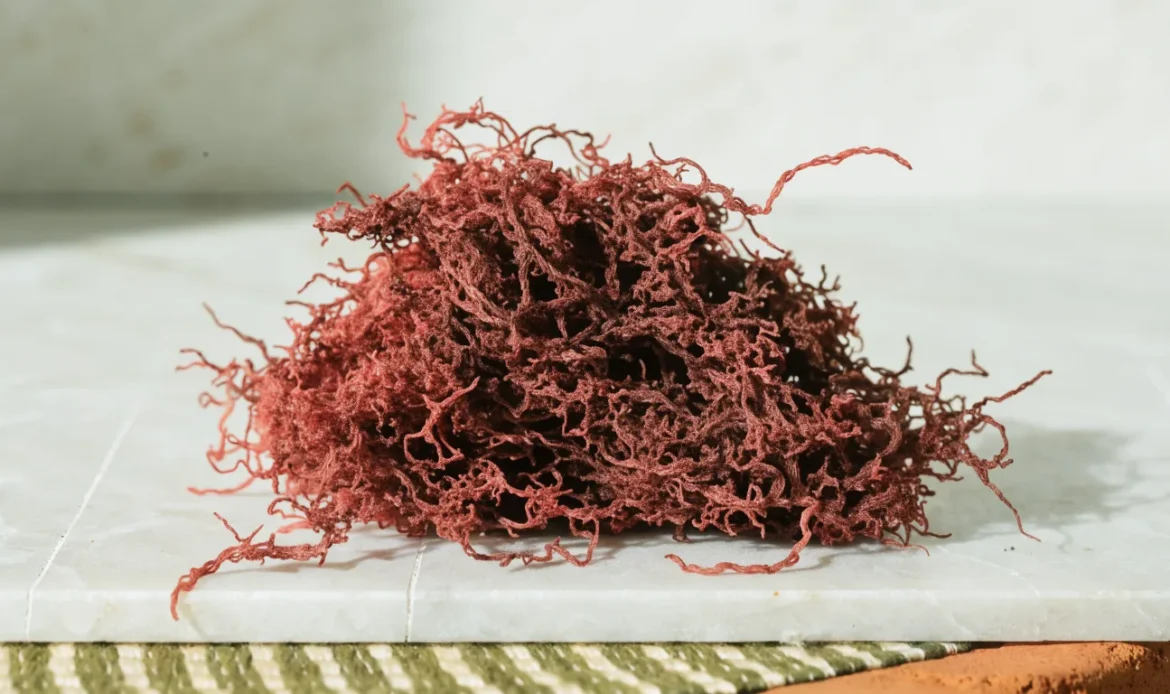
Short answer first: Red sea moss is a red-hued seaweed sold in forms such as raw pieces, dried strips, powdered flakes, gels, and capsules. It is a food ingredient with variable nutrients and variable iodine. Choose a format based on how you plan to use it, how much prep you want to do, and what safety information the seller shares.
Why this matters: color, form, and processing change how you use sea moss. But color alone does not prove nutrient content or safety. Read labels and seller information. Where needed, ask for test results.
What is red sea moss?
Red sea moss is a general name for seaweed with red or purplish tones. Seaweeds are grouped by color: red, brown, and green. Red seaweeds are one group of edible marine algae and are used in food and supplements around the world [1].
The “red” label refers to appearance. It does not guarantee a single species, a fixed nutrient profile, or a specific iodine level. Different coastal areas and different drying methods can change color. Many sellers use color names to help buyers, but color is only one clue.
Common formats and what they mean
Here are the main formats you will see. Each format changes how you store, prepare, and measure sea moss.
- Raw or fresh pieces. Whole or broken seaweed that needs cleaning and soaking. This is closest to the unprocessed form.
- Dried sea moss. Dehydrated strips or chips. Dried sea moss stores longer and is convenient to rehydrate.
- Powdered or flaked. Dried sea moss ground into powder. Easy to add to recipes and smoothies.
- Gel. Made by soaking and blending sea moss with water. Gel is ready to use in foods but is perishable and needs refrigeration.
- Capsules or supplements. Processed into pills or combined with other powders. These are regulated as supplements in many places and can vary in dose and composition [4].
- Blends and flavored products. Sea moss mixed with other foods or ingredients for taste and convenience.
How a form affects use:
- If you want to cook with sea moss, dried or raw works well.
- If you want a quick mixer for smoothies, gel or powder is easier.
- If you want an easy grab-and-take option, capsules may feel convenient, but check labeling and any test results.
Why red’s kitchen sea moss appears in searches
You may see the phrase “Red’s Kitchen Sea Moss” in product listings or recipes. That phrase is often used as a brand name or a home-style product name. It may refer to a prepared gel or a vendor’s specific product line. The basic meanings to watch for:
- It may describe a prepared gel meant for cooking or smoothies.
- It may be a seller’s product name rather than a scientific type.
- Always read the product description to know whether it is dried seaweed, a gel, or a supplement.
If you are unsure, ask the seller what format the product is, how it was processed, and whether a certificate of analysis (COA) or lab test is available.
Safety and what to check about iodine and other concerns
Seaweeds, including red types, can be a source of iodine. Iodine content varies a lot by species, location, and processing. That means one product may have little iodine and another may have much more [1][3].
Why iodine matters:
- Iodine affects thyroid function. Both low and very high iodine intake can affect the thyroid [2].
- Because seaweed iodine levels are variable, it is hard to predict how much iodine you will get from a serving of sea moss without testing.
What the research and official reports say:
- Seaweed can supply iodine, but levels differ widely by product and batch [1][3].
- Excessive iodine intake from seaweed has been documented as a risk in some settings and should be considered when using seaweed regularly [5].
- Supplements and sea moss products vary in labeling and testing, so read product information and third-party testing when available [4].
Other safety points:
- Contaminants: Seaweed can collect minerals and other substances from the water. Proper sourcing and testing can reduce risks, but labels and seller transparency matter.
- Microbial safety: Food handling matters. Gels and fresh forms can spoil if not stored or prepared safely.
What you can check before buying:
- Ingredient list and format (raw/dried/gel/powder/capsule).
- Storage instructions and expiration or best-by date.
- Whether the seller offers a certificate of analysis (COA) or third-party lab results for heavy metals, microbes, or iodine.
- Origin and processing details (where it was harvested and how it was cleaned/dried).
- Contact information and customer support if you have questions.
What this information cannot prove:
- A color term like “red” or “purple” cannot prove the iodine level or absence of contaminants.
- A short product description cannot replace a lab test for iodine or heavy metals.
- A seller’s origin statement does not automatically mean a product is free from environmental contaminants.
If you have thyroid issues or take iodine-sensitive medications, talk with a healthcare professional before adding seaweed-rich products to your diet. This article does not give medical advice.
Sources that support these safety points include public health and scientific overviews of seaweed and iodine risks and a review of supplement safety [1][2][3][4][5].
How to prepare red sea moss (basic steps)
The steps below describe a common home method. Exact times and methods vary by product and preference. Use safe food-handling practices.
- Inspect the product. For dried or raw sea moss, look for large pieces and remove obvious debris.
- Rinse briefly under cold running water to remove surface sand and salt.
- Soak in cold water. Soak times vary. Many people soak for several hours to overnight. The water will soften the seaweed.
- Rinse again after soaking to remove released sand or grit.
- Blend with clean water to make a gel. Typical ratios vary; make a gel thickness you prefer.
- Store the gel in a sealed container in the refrigerator. Use before the time suggested by the seller or by your own safe practice.
Note: Gels are perishable. If you plan to store for longer, freeze small portions in ice cube trays.
Comparing formats: a practical decision guide
Use this table to decide which format fits your needs. These are general notes, not promises about any specific product.
Format | Best for | Pros | Cons | What to check
—|—:|—|—|—
Raw/fresh pieces | Cooking, traditional recipes | Least processed; good for hands-on use | Short shelf life; needs cleaning | Seller’s handling and storage details
Dried sea moss | Long storage; home prep | Easier to store; rehydrates | Needs soaking and cleaning | Drying method and moisture content, prep instructions
Powder/flakes | Smoothies, baking | Easy to measure and mix | Particle size varies; may include fillers | Ingredient list and grind source
Gel | Smoothies, desserts, quick use | Ready-to-use; smooth texture | Short shelf life; refrigeration required | Refrigeration instructions and batch date
Capsules/supplements | Convenience, standardized dose | Easy to take | Variable labeling and testing | Supplement facts, third-party test info [4]
Blended products | Flavored use, convenience | Palatable, ready-made | May include sweeteners or other additives | Full ingredient list and sugar content
How to use the guide:
- Match the “Best for” column to how you want to use sea moss.
- Read the “What to check” column before buying.
- If you plan to use sea moss regularly, prioritize products that provide lab test information for iodine and heavy metals.
A practical checklist before you buy
Use this checklist to compare sellers and products. Tick boxes for items you want answered.
- [ ] Format matches my use (raw, dried, powder, gel, capsule).
- [ ] Product description clearly states format and preparation needs.
- [ ] Seller provides storage and expiration guidance.
- [ ] Ingredient list is complete with no unexpected additives.
- [ ] Seller offers contact information for questions.
- [ ] Third-party lab testing or COA is available for iodine and heavy metals (if you plan frequent use).
- [ ] Packaging shows batch number or production date.
- [ ] Return, shipping, and storage policies are clear.
- [ ] I understand how I will measure or dose the product for my recipes.
- [ ] I have considered medical or dietary factors (e.g., thyroid health) and will consult a professional if needed.
Purchasing tips for specific needs
Buying for food use or buying wholesale are different. Here are tips for both.
If you want sea moss for food or recipes:
- Choose a format that fits your cooking routine. Dried for pantry storage; gel for quick use.
- Ask about cleaning and drying steps if you plan to make gel at home.
- Check the ingredient list for added sugars or flavors if you want a plain product.
If you want sea moss for daily use or supplements:
- Look for clear labeling and any available third-party tests on iodine or contaminants.
- Understand the product’s shelf life and storage needs.
If you want to buy wholesale:
- Ask about minimum order sizes, packaging options, and lead times.
- Request sample documentation such as COAs and processing steps.
- Confirm shipping and cold-chain requirements if you are ordering gels or fresh forms.
For any purchase, be ready to ask the seller direct questions. If they cannot or will not answer basic questions about format, processing, or testing, that is a valid reason to consider alternatives.
What sellers can show you — and what they cannot prove
Good transparency items:
- Ingredient lists and format descriptions.
- Processing steps (washed, sun-dried, machine-dried).
- Storage and handling instructions.
- Certificates of analysis (COA) for specific batches.
- Contact details and return policies.
Things these items cannot prove by themselves:
- A color name does not equal nutrient level.
- An origin label does not guarantee absence of environmental contamination.
- Seller claims of “pure” or “wild-harvested” do not prove testing or safety without supporting documentation.
When you see a COA, read what it covers. A COA that tests for iodine and heavy metals is different from a basic identity test. If you want to know iodine content, ask for an iodine test or a COA that includes it.
Next guides and useful links
If you want to read more practical content, these pages can help:
- Start here: Home
- More background on products and formats: /learn/
- See product options: /shop/
- If you buy in bulk: /wholesale/
- Questions or special orders: /contact/
(These links lead to general guides and contact pages where you can ask for specifics.)
Conclusion
Red sea moss is a common food ingredient sold in several formats. Color names like “red” help identify a group of seaweeds, but they do not give a full picture of nutrients, iodine content, or safety. Choose a format that fits how you plan to use it. Before buying, read product descriptions, ask sellers for COAs or testing when needed, and use the checklist here to compare options. If you have thyroid issues or take iodine-sensitive medicine, consult a healthcare professional before adding seaweed products to your routine.
For more on formats, preparation, and buying tips, return to our main learn pages at /learn/ ( /learn/ ) or browse product options at /shop/ ( /shop/ ). If you need bulk options, see /wholesale/ ( /wholesale/ ) or contact us directly via /contact/ ( /contact/ ).
Continue reading
Frequently asked questions
Is red sea moss the same as Irish moss?
Not always. “Irish moss” commonly refers to certain red seaweeds, but names overlap. Labels can vary by seller and region. Always check the product format and description.
How do I know how much iodine is in a product?
Iodine levels vary by species and batch. Ask the seller for a certificate of analysis (COA) that lists iodine. Without testing, you cannot reliably know iodine content [3][5].
Does the color tell me about safety or nutrients?
Color can hint at species or drying method, but it does not prove nutrient content or safety. Testing and transparent labeling are the reliable ways to know more.
What is the best format for smoothies?
Gel and powder are most convenient for smoothies. Gel blends smoothly; powder mixes easily. Choose whichever matches your prep time and storage ability.
How long does sea moss gel last in the fridge?
Gel is perishable and storage times vary by how it was prepared and refrigerated. Follow the seller’s storage guidance and use safe food-handling practices. If in doubt, freeze small portions.
Are sea moss capsules regulated and safe?
Capsules are regulated as dietary supplements in many places. Regulations and testing vary by jurisdiction. Look for clear labeling and third-party testing if safety is a priority [4].
References
- Harvard T.H. Chan School of Public Health, “Seaweed.” https://nutritionsource.hsph.harvard.edu/seaweed/
- Smyth PPA. “Iodine, Seaweed, and the Thyroid.” European Thyroid Journal, 2021. https://pmc.ncbi.nlm.nih.gov/articles/PMC8077470/
- Food Standards Australia New Zealand, “Survey of iodine levels in seaweed and seaweed containing products,” updated 2025. https://www.foodstandards.gov.au/science-data/monitoring-safety/surveyofiodinelevels
- Operation Supplement Safety, “Sea Moss in Dietary Supplements.” https://www.opss.org/article/sea-moss-dietary-supplements
- Blikra MJ et al. “Consequences of acute and long-term excessive iodine intake: A literature review focusing on seaweed as a potential dietary iodine source.” 2024. https://doi.org/10.1111/1541-4337.70037