
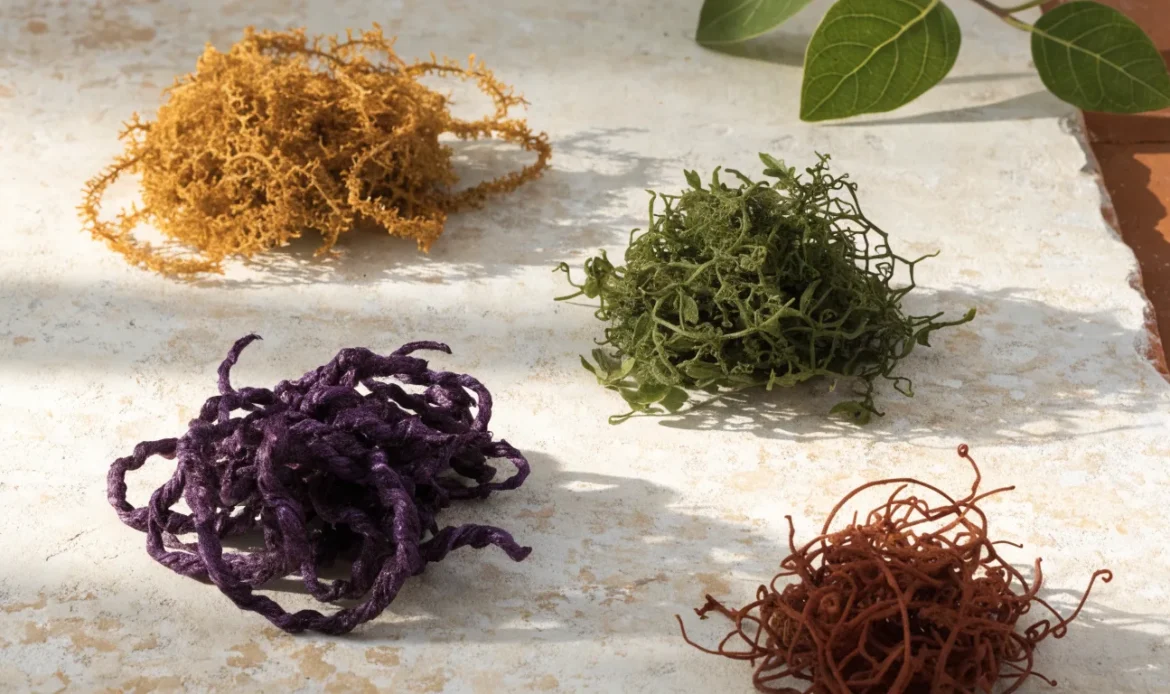
Short answer: “Different types of sea moss” can mean different species, different natural colors, or different product formats (dried, gel, powder, capsules). Which type is “best” depends on what you want to use it for, how you want to prepare it, and which sourcing and safety checks you require.
This guide answers the question quickly, then explains the main species and color groups, common product formats, safety and testing to look for, and a practical buyer checklist. Links to practical next steps are at the end.
What people mean by “different types of sea moss”
When someone asks about different types of sea moss they usually mean one of three things:
- Species: different seaweed species are commonly sold as “sea moss.” These include red and green algae groups. Species affect texture and how you can use the seaweed.
- Color: sea moss can appear gold, purple, green, brown, or black. Color is a clue, not a guarantee of species or quality.
- Product format: whole dried seaweed, raw fresh seaweed, sea moss gel, powders, and capsules. Format changes how you prepare and store it.
We will cover each meaning so you can compare and decide.
Common species and how they differ
Here are species you will often see labeled or implied in sea moss products.
- Chondrus crispus (often called Irish moss)
- A red alga that grows in cold to temperate waters.
- Often used as a thickener (carrageenan-like compounds are naturally present).
- Texture tends to be firm when cooked.
- In retail, it is often sold dried or as a gel.
- Gracilaria species
- A group of red algae found in warmer waters.
- Often softer and more flexible than Chondrus.
- Commonly sold in Caribbean markets and online as “sea moss” for food and supplements.
- Frequently used in dried and gel formats.
- Eucheuma and Kappaphycus species
- Tropical red algae often used in commercial carrageenan production.
- When sold as whole seaweed, they can be thicker and fibrous.
- Less commonly sold to consumers as raw “sea moss” but they appear in some supplier products.
Notes:
- Common retail names sometimes mix species terms or use regional common names. The same species can look different depending on where and when it was harvested.
- Sellers do not always list the scientific species on the product label. If species matters to you, ask the seller for the species name and any identification documentation.
Color differences: what color can tell you
Sea moss color is visually obvious, but color alone does not prove quality or species. Common colors you’ll see:
- Gold (or yellow)
- Purple
- Green
- Brown or black
- Off-white or faded after drying
Why colors vary:
- Species genetics. Some species are naturally more pigmented.
- Environmental conditions. Light, water temperature, nutrients, and algae growth stage affect color.
- Surface growths and epiphytes. Tiny organisms growing on the seaweed can change its look.
- Drying and processing. Sun-drying, air-drying, or machine drying can shift color. Heat or long drying times can fade pigments.
What color cannot tell you reliably:
- Exact species (color hints at species but is not definitive).
- Safety or contamination levels. A bright color does not mean “safer” or “cleaner.”
- Nutrient content or iodine level. Those vary by species and environment and require lab testing to measure.
In short, color is a useful clue for preference and aesthetics, but it is not proof of origin, purity, or nutrient content.
Product formats and when to pick each
Formats change how you use sea moss and how long it lasts.
- Whole dried sea moss
- What it is: cleaned, dried seaweed. Often sold in handfuls.
- Good for: DIY gel, cooking, long-term storage.
- What to check: Look for clean pieces, minimal sand, and clear seller instructions for cleaning and rehydrating.
- Raw fresh (wet) sea moss
- What it is: recently harvested and washed seaweed sold wet.
- Good for: immediate gel or culinary use.
- What to check: Fresh smell (not rotten), clear harvest date, and storage instructions.
- Sea moss gel
- What it is: soaked and blended sea moss, stored as a gel.
- Good for: smoothies, soups, topical use (cosmetic), and quick use.
- What to check: Ingredients list (ideally only sea moss + water), expiry date, and storage instructions (refrigeration).
- Powdered sea moss
- What it is: dried sea moss ground to a powder.
- Good for: adding to dry mixes, capsules, or recipes where texture of gel is unwanted.
- What to check: Particle consistency and whether the product is pure seaweed or a blend.
- Capsules or tablets
- What it is: powdered sea moss in pill form.
- Good for: people who want convenience.
- What to check: Ingredients, serving size, and whether the product has been third‑party tested.
Different formats suit different uses. If you plan to cook or make your own gel, whole dried sea moss gives you more control. If you want quick convenience, gel or capsules are practical. But always read the label and ask sellers about processing and testing.
Safety, iodine, and contamination: what to check and why
Seaweeds can contain useful minerals but also high levels of iodine and environmental contaminants. Do not assume any product is safe just because it looks clean.
Key safety points to check:
- Iodine variability
- Iodine content varies widely between species and harvests. Some seaweeds can have high iodine levels that may affect people with thyroid conditions or those taking iodine-sensitive medications [1][2][5].
- If iodine matters to you, ask for iodine testing results or choose species and products that provide that information.
- Heavy metals and contaminants
- Seaweed can bioaccumulate metals or pollutants present in the water. Reliable sellers test for contaminants and share results. If no testing information is available, consider that an uncertainty to weigh [1].
- Food-safety authorities recommend testing and monitoring seaweed products for safety [3].
- Product labeling and ingredients
- Check the ingredients list. Avoid products with unclear additives if you want pure sea moss.
- For processed forms (powders, capsules, gels), look for manufacturing and storage details.
- Third-party testing and certificates
- Ask sellers for third-party or independent lab testing that covers iodine, heavy metals, and microbial contamination. This is especially important for powders, capsules, or concentrated products [4].
What the research sources tell us:
- General guidance on seaweed nutrition and variability from the Harvard T.H. Chan School of Public Health stresses that seaweed is a diverse group and content varies, so consumers should be cautious and informed [1].
- Scientific reviews and monitoring reports highlight the potential for high iodine intake and the need for careful use of seaweed products [2][3][5].
- Operations and regulatory guides point out that supplement-style sea moss products may have different safety requirements and that consumers should look for reliable manufacturing details [4].
We cannot test products here. When a seller gives you test results, ask who did the testing, what parameters were measured, and when the test happened.
How to choose the best type of sea moss for your needs
There is no single “best type of sea moss” for everyone. Use a decision approach based on use, safety needs, and convenience.
Decision steps:
- Define your main use.
- Culinary thickener? Choose species with gel-forming traits and whole dried formats.
- Daily convenience? Consider gel, powder, or capsules with clear ingredient lists.
- Cosmetic use? Look for gels labeled for topical use and manufactured hygienically.
- Ask for species and test results.
- If species matters, ask the seller for the scientific name.
- Request lab reports for iodine and heavy metals if you will consume sea moss often or in large amounts.
- Check processing and storage.
- For dried sea moss: ask about cleaning and drying methods.
- For gels: check refrigeration needs and preservatives.
- For powders and capsules: check manufacturing facility and test results.
- Consider sensory cues.
- Smell: fresh sea scent is normal; spoiled smell is not.
- Look: pieces should be intact without heavy debris.
- Texture: after rehydrating, the feel can tell you about species and processing.
- Start with a small purchase.
- If you are uncertain, buy a small amount first. Use it and see whether it meets your expectations for texture and preparation instructions.
Below is a practical decision guide to help you match goals to types and checks.
Practical decision guide (table)
| Use-case / Goal | Likely Best Type / Species | Good Format | What to check before buying | Quick reason |
|---|---|---|---|---|
| Make gel for smoothies or skincare | Gracilaria or Chondrus (seller should name species) | Whole dried or fresh | Ask for cleaning steps; check seller instructions for soaking/blending | Whole forms let you make your own gel and control added ingredients |
| Cooking as a thickener | Chondrus or Eucheuma varieties | Whole dried | Verify species; check preparation tips (soak time, rinse) | Some species gel more strongly when cooked |
| Convenience & quick use | Powders, pre-made gels, or capsules | Powder or gel | Ingredients list; shelf-life and storage; lab testing if used daily | Easy to add to recipes or take without prep |
| Topical / cosmetic use | Any cleaned sea moss with clear processing | Clean gel in sealed jar | Confirm it’s made in hygienic conditions; check for preservatives | For skin use, hygienic production matters |
| Frequent daily intake | Species with known low iodine (ask seller/test results) | Powder or whole dried (with tests) | Request iodine and heavy metal test reports; ask about serving sizes | Regular intake increases importance of testing |
Use this table as a guide, not a rule. If you need professional medical advice about iodine or interactions, ask a healthcare provider.
How to read seller claims and what they cannot prove
When comparing products, sellers may use appealing words. Here’s how to read those claims.
Claims to treat with caution:
- “High in [nutrient]” or “detoxifies” — nutrient content varies and claims about detox or medical benefits are not appropriate without clinical evidence. Avoid relying on such claims.
- “Laboratory tested” — ask who did the testing and what was measured. A test report is useful; a claim alone is not.
- “Wild-harvested” or “sustainably harvested” — these terms mean different things. Ask for details about harvest areas and sustainability practices.
- Color-based superiority claims — color does not automatically mean better nutrients or safety.
Questions to ask sellers:
- What species is this product?
- Can you provide recent lab results for iodine and heavy metals?
- How was the sea moss cleaned and dried?
- What is the recommended serving size and storage method?
- Where was the sea moss harvested and processed? (If they can’t say, weigh that uncertainty.)
Preparing sea moss safely: brief, practical steps
General simple steps for whole dried sea moss:
- Rinse under cool water to remove sand and debris.
- Soak in clean water until rehydrated. Change the water if it becomes cloudy.
- Trim off any hard stems or discolored parts.
- Blend soaked sea moss with fresh water to make gel.
- Store gel in a clean, sealed container in the refrigerator and use according to seller guidance.
For all formats:
- Follow storage instructions on the package.
- Throw away products that smell bad, show mold, or change texture unexpectedly.
- If you have a thyroid condition or take iodine-sensitive medication, check with a healthcare provider before regular use and seek iodine testing information for the product [2][5].
Questions to ask before buying (short checklist)
- What is the scientific species name?
- Can you provide recent lab testing results (iodine, heavy metals, microbial)?
- How was the sea moss cleaned, dried, and stored?
- What ingredients are in this product?
- What is the recommended serving size and shelf life?
- Who did the testing and when was it done?
Keep a copy of test results and product labels if you plan to use the product regularly.
Links for next steps
- Learn more about seaweed basics on our learning hub: /learn/
- Read more practical guides and recipes: /learn/
- Browse product formats and options in our shop: /shop/
- See our wholesale options and sourcing questions: /wholesale/
- Contact us with product or testing questions: /contact/
- Return to our homepage: /
Conclusion
Different types of sea moss can mean different species, colors, or product formats. There is no single “best” type for everyone. The best choice depends on your use, how often you plan to consume it, and how much testing and transparency you need. Use the checklist and decision table in this guide to compare products. Always ask sellers for species information and lab test reports if you plan to use sea moss often. If you have a health condition or concern about iodine, speak with a healthcare professional.
Continue reading
Frequently asked questions
Is one color of sea moss better than another?
Color alone does not prove better quality. Color is influenced by species, water, and processing. Use color as one factor but also ask for species, cleaning methods, and tests for safety.
Which sea moss species is most common for making gel?
People commonly use Gracilaria and Chondrus species to make gel. Both can produce a thick texture, but texture and gel strength vary by species and processing. Ask the seller which species they sell.
Should I worry about iodine from sea moss?
Sea moss can have variable iodine levels. Some seaweed types may have high iodine. If iodine matters to you — for example if you have a thyroid condition — ask for iodine testing results and consult a healthcare provider before regular consumption [1][2][5].
Is sea moss safe for children or pregnant people?
Safety depends on iodine content and contaminant levels. Because iodine and contaminants can affect sensitive groups, ask for lab testing and consult a healthcare provider before use.
What does it mean if a seller does not provide testing results?
Lack of testing information means there is uncertainty about iodine and contaminants. If you plan to use sea moss regularly, prioritize sellers who provide clear, recent testing data.
Can I use sea moss topically?
Many people use sea moss gels in skincare. If you plan topical use, choose products made in hygienic conditions and check the ingredients to avoid irritants or unwanted additives.
References
- Harvard T.H. Chan School of Public Health, “Seaweed.” https://nutritionsource.hsph.harvard.edu/seaweed/
- Smyth PPA. “Iodine, Seaweed, and the Thyroid.” European Thyroid Journal, 2021. https://pmc.ncbi.nlm.nih.gov/articles/PMC8077470/
- Food Standards Australia New Zealand, “Survey of iodine levels in seaweed and seaweed containing products,” updated 2025. https://www.foodstandards.gov.au/science-data/monitoring-safety/surveyofiodinelevels
- Operation Supplement Safety, “Sea Moss in Dietary Supplements.” https://www.opss.org/article/sea-moss-dietary-supplements
- Blikra MJ et al. “Consequences of acute and long-term excessive iodine intake: A literature review focusing on seaweed as a potential dietary iodine source.” 2024. https://doi.org/10.1111/1541-4337.70037