
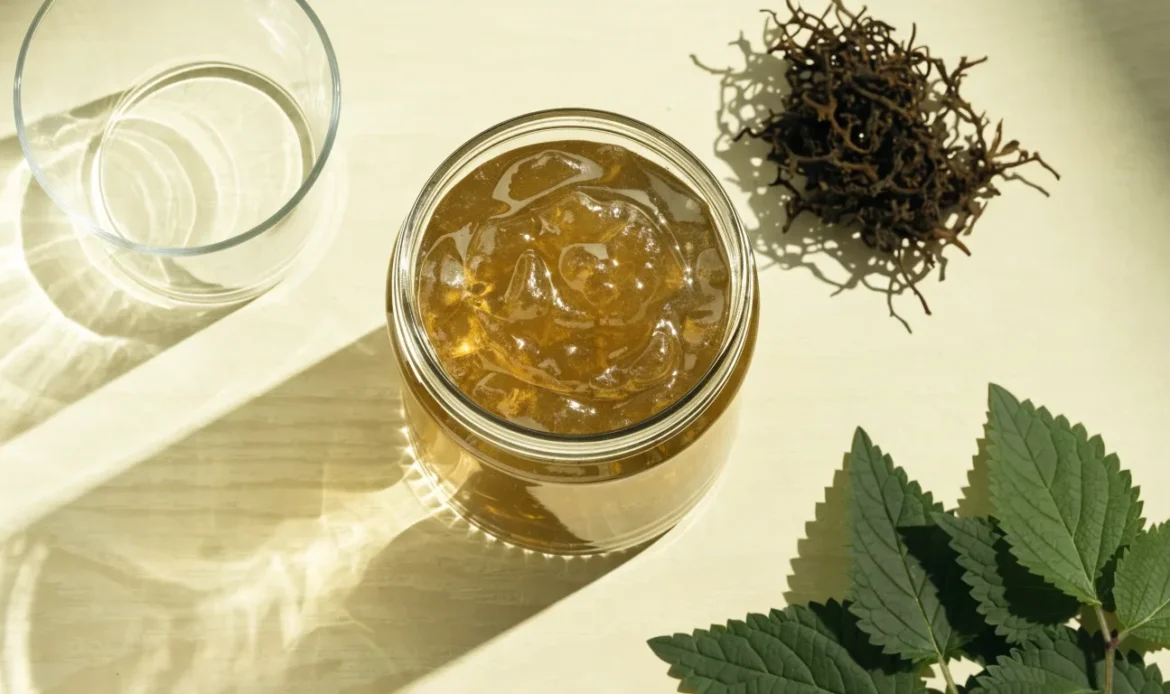
Short answer: “Sea moss” in Spanish is most often called musgo de mar or musgo marino. People also use terms like alga marina or alga roja depending on the region. Below you’ll find clear Spanish words, how products are sold and labeled, safety points (especially about iodine), and a practical checklist to help you buy or prepare sea moss.
What “sea moss” means in plain words
Sea moss is a common name for several kinds of seaweed. In English it usually means certain red seaweeds people use as food, gel, or supplement. Seaweeds are a broad group of marine plants and algae. They come in many colors and textures. Some are eaten as food. Others are used to make gels, powders, and supplements.
For general facts about seaweed types and how people use them, see a trusted source on seaweed basics [1].
Spanish names: quick list you can use
Common Spanish names you will see on labels or menus:
- musgo de mar — the direct translation of “sea moss.”
- musgo marino — same meaning; common in casual speech.
- alga marina — means “seaweed” and is a broader term.
- alga roja — “red algae”; useful when the product is a red species.
- carragenina (or carragenano on some labels) — a term related to a thickening agent derived from some red algae. This word is not the name for sea moss itself, but you may see it on ingredient lists.
- names by species or local names — in some places, sellers use local plant names. If you see a Latin species name on a label, that is more specific than the generic terms above.
If you read a label in Spanish and see “natural,” “seco,” “en polvo,” “en gel,” or “cápsulas,” those words tell you the product form: natural (raw), seco (dried), en polvo (powder), en gel (gel), cápsulas (capsules).
How sea moss is commonly sold and labeled
Forms you can expect to find, and typical Spanish label phrases:
- Dried whole seaweed — label: “alga seca,” “musgo de mar seco.”
- Fresh or wet seaweed — label: “alga fresca,” “fresca.” Fresh forms are less common in retail outside coastal markets.
- Sea moss gel — label: “gel de musgo de mar” or “gel de alga.” Gel is made by soaking and blending sea moss with water.
- Powdered sea moss — label: “polvo de musgo de mar” or “alga en polvo.”
- Capsules or pills — label: “cápsulas” or “complemento alimenticio.”
- Blends or products with other ingredients — label will list other ingredients in Spanish, e.g., “con jengibre” (with ginger) or “azúcar” (sugar).
Look on the package for ingredient lists (lista de ingredientes), net weight (peso neto), and country of origin (país de origen) if provided. Many labels will not list everything a careful buyer wants to know. This article helps you read what is there and what to ask next.
Words and phrases to spot on Spanish labels, and what they mean
- Lista de ingredientes — ingredient list. Read it first.
- Porciones / dosis — servings / dose. Useful for supplements.
- Lote / número de lote — batch number; helpful if you need to trace a product.
- Fecha de caducidad / consumir antes de — expiration or best-before dates.
- Producto natural / sin aditivos — natural / no additives. These claims require caution; they don’t prove safety or testing.
- Certificado / análisis de laboratorio — certificate / lab analysis. If present, ask for the full report, not just the word “certificado.”
If a product uses scientific or local names, compare them with the common Spanish words above. If a seller uses only marketing terms, ask for details.
Safety and testing: what you should check and what labels cannot prove
Seaweeds can carry both useful culinary qualities and some risks. Two safety themes to know in plain language:
- Iodine content can vary a lot. Some seaweeds are naturally high in iodine. If you have a thyroid condition, are pregnant, or are taking iodine-sensitive medicines, check with a healthcare professional before regular use. Reviews and surveys have shown that iodine levels vary by species and harvest [2] [3] [5].
- Contaminants may appear. Seaweed can pick up minerals and trace elements from its environment. Labels alone rarely prove a product is tested for contaminants. If testing matters to you, look for specific lab reports or ask the seller for batch testing.
A helpful review explains how iodine from seaweed affects the thyroid and why monitoring matters [2]. A recent literature review highlights possible consequences of consuming too much iodine and recommends care with seaweed intake [5]. A government survey shows that iodine levels in seaweed products can be unpredictable [3]. Use these facts to guide questions to sellers.
Regulation note: dietary supplements and seaweed products are regulated differently by country. In many places, a product labeled as a “complemento alimenticio” or “suplemento” is not reviewed the same way as a prescription drug. Operation Supplement Safety outlines general concerns for sea moss in supplements and advises caution about label claims and testing [4].
How to read testing claims and certificates (what to ask for)
If a seller or label mentions testing, ask these clear questions:
- Is the test a third-party lab or an in-house test?
- Does the certificate cover iodine and heavy metals? Which ones? (e.g., lead, arsenic, cadmium)
- Does the certificate match the product batch number (número de lote)?
- Can I see the full lab report or at least a certificate of analysis (COA)?
- When was the sample taken and tested?
If the seller cannot answer or produce documents, treat the product as unverified. A label cannot prove safety by itself.
Simple preparation and storage tips (food use, not medical advice)
If you plan to cook or make gel from sea moss, here are plain steps people commonly use. These are general kitchen tips, not medical directions.
- Rinse: Rinse dried sea moss under running water to remove sand and small debris. Use cool water.
- Soak: Soak in fresh water until it softens. Soaking times vary by product. If the product is labeled “seco,” expect to soak.
- Blend: For gel, drain the soaked sea moss, then blend with fresh water until smooth. Store the gel in a clean container in the refrigerator.
- Cook: If you plan to add sea moss to recipes, follow a recipe for amounts and cooking times.
- Store: Follow the product’s storage instructions. For homemade gel, refrigeration is standard. For dried seaweed, keep it dry and sealed.
These are food handling tips. If you have health conditions or take medicines, consult a healthcare professional before adding sea moss to your routine.
Decision checklist: How to choose a sea moss product (Spanish-friendly)
Use this checklist when you compare products. The table shows what to look for, why it matters, and a short Spanish phrase you might find on the label.
| Check | Why it matters | Example Spanish label phrase |
|---|---|---|
| Form (dried, gel, powder, capsule) | Different forms change how you use it and store it | “alga seca”, “gel de musgo”, “polvo” |
| Ingredient list present | Shows additives or blend ingredients | “Lista de ingredientes” |
| Batch number / lote | Needed to trace a product if testing is available | “Lote: 12345” |
| Lab testing / COA | Tests can show iodine levels and contaminants | “Análisis de laboratorio” or “Certificado” |
| Iodine info or warning | Important if you have thyroid issues | “Contenido de yodo” or a health warning |
| Country of origin | Useful for sourcing questions, not a safety guarantee | “País de origen” |
| Expiration / fecha de caducidad | For shelf-stable handling and freshness | “Consumir antes de” |
| Seller transparency | Can the seller answer questions and show documents? | N/A — ask directly |
Use the checklist as a short decision tool. If a product checks several boxes (clear ingredient list, visible batch number, and available lab report), that increases the information you have to make a choice. It does not guarantee safety.
Comparing formats: pros and limits (short, practical)
- Dried whole seaweed: easy to store, takes time to prepare. Labels may not state iodine.
- Gel: ready-made for recipes, shorter shelf life. Check refrigeration instructions.
- Powder: convenient for mixing. Look for ingredient lists and fillers.
- Capsules/supplements: convenient doses but may hide the amount of seaweed and iodine. Check dosage and lab tests.
No format is inherently safer. The difference is how easy it is to measure, store, and test.
Questions to ask your seller, in Spanish or English
If you shop in Spanish, here are short, useful phrases you can use:
- ¿De dónde proviene este producto? (Where does this product come from?)
- ¿Tiene análisis de laboratorio por lote? (Do you have lab testing by batch?)
- ¿Qué especie de alga es esto? (What species of seaweed is this?)
- ¿Cómo debo conservarlo? (How should I store it?)
- ¿Contiene otros ingredientes? (Does it contain other ingredients?)
A clear seller will answer directly or offer to send lab info.
Regulations and label claims: a plain note
Label claims like “natural” or “apto para embarazadas” (suitable for pregnant women) mean nothing without evidence. In many countries, food and supplement labels are not proof of safety or effectiveness. If a product claims a health benefit in Spanish, request supporting lab data or ask a healthcare professional before using the product regularly.
Operation Supplement Safety flags that supplement labels can be incomplete and that sea moss products have regulatory gaps in some markets [4]. This means you need to be an active reader of labels and not rely solely on marketing.
When to talk to a healthcare professional
Talk to a healthcare provider if you:
- Have thyroid disease. Seaweed contains variable iodine. A professional can advise if you should avoid or limit use [2] [5].
- Are pregnant or breastfeeding. Many medical organizations recommend checking iodine intake during pregnancy; some seaweeds are high in iodine [2].
- Take medications sensitive to iodine or minerals from seaweed.
- Plan to use sea moss as a regular dietary supplement.
A professional can help you interpret lab reports or decide whether a product is appropriate for you.
Next steps and useful links
If you want to read more or shop, here are helpful internal pages:
- Learn more about sea moss basics at our learn hub: /learn/
- Browse product options: /shop/
- If you buy in bulk, see our wholesale information: /wholesale/
- Contact us with specific product questions: /contact/
- Back to home: /
These pages can help you compare forms, request lab reports, or make a purchase decision.
Conclusion
“Sea moss en español” generally translates to musgo de mar or musgo marino, with alga marina and alga roja also used. Labels and local names vary by region and product form. Look for clear ingredient lists, batch numbers, and third-party lab tests if safety or iodine content matters to you. Labels alone do not prove safety. If you have thyroid issues, are pregnant, or take medicines, speak with a healthcare professional before using seaweed regularly. Use the decision checklist and the label questions in this article to guide your next steps.
Continue reading
Frequently asked questions
¿Sea moss en español es “musgo de mar” o “alga marina”?
Both are used. “Musgo de mar” and “musgo marino” are common for “sea moss.” “Alga marina” is a broader term for seaweed. Labels may use either.
¿Puedo confiar en la palabra “natural” en la etiqueta?
Not by itself. “Natural” is a marketing term. Ask for ingredient lists, batch numbers, and lab reports if testing matters to you.
¿Necesito preocuparme por el yodo?
Yes, iodine levels can vary a lot by species and harvest. If you have thyroid concerns or are pregnant, ask a healthcare professional before frequent use [2] [5] and consider products with test results showing iodine levels [3].
¿Cómo sé si un gel de sea moss está en mal estado?
Follow storage instructions. If a gel smells off, shows mold, or the packaging is bloated, do not use it. When in doubt, throw it out.
¿Qué significa “carragenina” en una etiqueta en español?
Carragenina (or carragenano) refers to a family of polysaccharides from some red seaweeds used as thickeners. It is not the same as “sea moss” itself but may appear as an ingredient in processed foods.
¿Dónde puedo comprar sea moss con información clara?
Look for sellers who provide ingredient lists, batch numbers, and third-party lab reports. Ask questions using the checklist above. For product options, see our shop or wholesale pages (links below).
References
- [1] Harvard T.H. Chan School of Public Health, “Seaweed.” https://nutritionsource.hsph.harvard.edu/seaweed/
- [2] Smyth PPA. “Iodine, Seaweed, and the Thyroid.” European Thyroid Journal, 2021. https://pmc.ncbi.nlm.nih.gov/articles/PMC8077470/
- [3] Food Standards Australia New Zealand, “Survey of iodine levels in seaweed and seaweed containing products,” updated 2025. https://www.foodstandards.gov.au/science-data/monitoring-safety/surveyofiodinelevels
- [4] Operation Supplement Safety, “Sea Moss in Dietary Supplements.” https://www.opss.org/article/sea-moss-dietary-supplements
- [5] Blikra MJ et al. “Consequences of acute and long-term excessive iodine intake: A literature review focusing on seaweed as a potential dietary iodine source.” 2024. https://doi.org/10.1111/1541-4337.70037