
Short answer: It depends. Sea moss is a type of seaweed with variable nutrients. The main worry in pregnancy is iodine. Some seaweed products have very high iodine. Iodine affects the thyroid, which matters for pregnancy. Evidence on sea moss supplements in pregnancy is limited. Talk with your clinician before you start. This article explains the reasons, what you can check, and a simple safety checklist to help you decide.
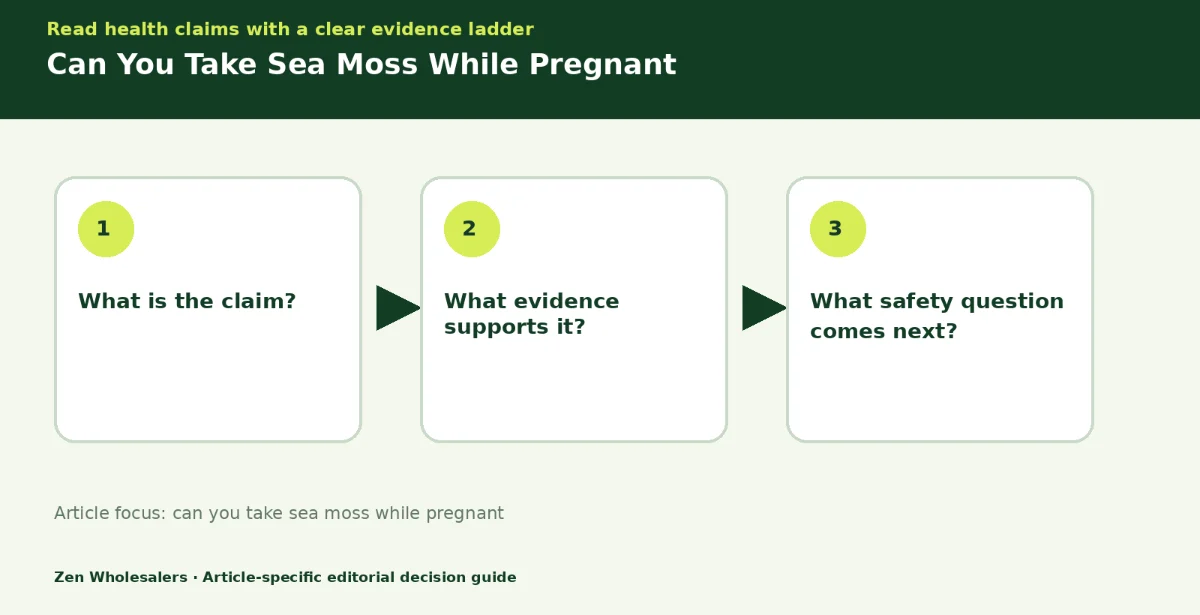
Why answer first
- People want a clear yes or no. There is no single answer that fits everyone.
- This guide shows what to check and when to get medical advice.
What is sea moss?
Sea moss is a common name for certain red or brown seaweeds used in food and supplements. Different species and growing areas make big differences in what is inside the plant. Seaweed can contain minerals, including iodine, and other compounds that vary by species and source. For general info on seaweed nutrition and variety, see the Harvard Nutrition Source summary on seaweed. [1]
Why people consider sea moss during pregnancy
Some people use sea moss as a food or a supplement because it is part of traditional diets in some places. Seaweed can contain vitamins and minerals that people associate with general nutrition. However, traditional use or a nutrient presence does not prove that a supplement is safe or helpful during pregnancy. The amount of any nutrient in sea moss products can change by species, harvest location, and processing.
The main safety concern: iodine
Iodine is a key reason to be cautious. Iodine helps the thyroid make hormones. During pregnancy, thyroid hormones are important for both the mother and the developing fetus. Too little iodine is a problem, and too much iodine can also cause thyroid problems. Seaweeds can contain a lot of iodine, but the amount is highly variable across types and products. [2] [3]
- Some seaweed types tend to be high in iodine. The exact iodine level can vary a lot even within the same type, depending on where and how the seaweed was harvested and processed. [3]
- Excessive iodine intake can lead to thyroid dysfunction in some people. This is a key safety concern for pregnant people because thyroid changes can have effects that need clinical monitoring. [5]
Given this variability, a sea moss product might contain a low, moderate, or very high amount of iodine. You usually cannot tell by look or taste. Product labeling often does not list iodine content. For these reasons, many experts urge caution with seaweed supplements and products that do not provide clear iodine testing. [4]
Other safety concerns: supplements and contaminants
Beyond iodine, sea moss supplements may vary in quality. Products sold as “sea moss” can be raw seaweed, powders, gels, or capsule extracts. The manufacturing process, source control, and testing vary by brand. Operation Supplement Safety notes that sea moss dietary products can have inconsistent ingredient amounts and may not be tested for contaminants. [4]
Possible issues include:
- Unknown ingredient amounts in supplements.
- Lack of third-party testing.
- Contaminants carried from the water where the seaweed grew (this can include microbes or metals in some cases, depending on source and processing). Reliable testing is the only way to know.
Because of these uncertainties, many clinicians recommend caution with seaweed supplements during pregnancy, unless a product shows clear testing and you have clinician approval.
What the research says — food composition vs clinical proof
It helps to separate three types of information:
- Food composition data and surveys. These measure how much iodine or other elements are in different seaweeds and products. They show wide variability. [3]
- Laboratory and observational studies. Some early research looks at the nutrient content of seaweeds or suggests areas for study. These do not prove safety or benefit in pregnant people.
- Clinical trials in pregnant people. High-quality trials testing sea moss supplements in pregnancy are limited or absent. That means we lack strong proof that taking sea moss supplements is safe or helpful in pregnancy.
In short, we have good reason to know iodine can be high and that excess iodine can affect the thyroid. We do not have strong clinical trial evidence showing sea moss supplements are safe for pregnant people. [1] [2] [4] [5]
A practical decision checklist
Use this checklist to help decide whether to use sea moss while pregnant. Follow the checklist step by step and stop if one item suggests caution.
- Ask your clinician first
- If you are pregnant or planning pregnancy, ask your OB/GYN, midwife, or primary care clinician before using sea moss or any new supplement.
- Note your thyroid history
- If you have thyroid disease, past thyroid tests out of range, or take thyroid medicine, do not use sea moss without clinician approval.
- Identify the product form
- Food (e.g., culinary seaweed), raw seaweed, gel, powder, capsule, or extract. Supplements have more quality variability than whole, packaged food. [4]
- Check the label for iodine or test results
- Look for a clear iodine amount, third-party testing, or a certificate of analysis (COA). If the product does not list iodine or provide lab testing, treat it as “unknown iodine.”
- Consider other iodine sources in your diet
- Think about iodized salt, dairy, seafood, or any prenatal vitamin that may contain iodine. Talk with your clinician about total iodine intake. [2]
- If the iodine amount is high or unknown, avoid the product
- If the product lists very high iodine, or if the iodine amount is unknown and you have no clinician guidance, do not use it during pregnancy.
- Prefer products with clear third-party testing
- If you and your clinician decide to use a sea moss product, choose one that provides COAs for iodine and contaminants. [4]
- Monitor and test if your clinician recommends it
- Your clinician may suggest thyroid function tests (for example, TSH) before or during use. Follow their advice on monitoring. [2]
Use this short decision map:
- Pregnant and thyroid disease → Talk to clinician; avoid unknown iodine products.
- Pregnant and no thyroid history but product iodine unknown → Ask clinician; likely avoid.
- Pregnant, product shows low iodine and clinician approves → May consider under clinical supervision.
- Never start a supplement without clinician approval in pregnancy.
(Do not interpret “may consider” as a recommendation. It means discuss with your clinician.)
Quick table: Product type and typical risk
| Product form | Typical concern | What to check |
|---|---|---|
| Whole culinary seaweed (known species, small amounts) | Iodine can still be high; variability | Ask clinician; check species and portion size |
| Raw sea moss or homemade gel | Iodine and contamination unknown | Avoid unless tested and clinician OK |
| Packaged supplement (capsule/powder) | Ingredient variability, lack of iodine info | Look for COA, iodine listing, third-party testing [4] |
| Product with lab results listing iodine | Lower unknown risk if tests are recent and reputable | Verify lab, discuss with clinician |
How a clinician will likely evaluate risk
A clinician will consider:
- Your medical history, especially thyroid issues.
- Current prenatal vitamin and dietary iodine intake.
- The specific product and any lab results the maker can provide.
- Whether testing is needed now (thyroid function tests) or later.
If your clinician thinks there is a potential iodine risk, they may order thyroid function tests or advise against sea moss until after pregnancy.
Safety and when to ask a clinician
Ask your clinician before using sea moss if you are pregnant, breastfeeding, or plan to become pregnant. Also ask if:
- You have a history of thyroid disease or abnormal thyroid tests.
- You take thyroid medication or other prescription drugs.
- You are unsure about the product’s iodine content, origin, or testing.
Seek medical help if you experience new or worsening signs that might suggest a thyroid change while pregnant. General signs can include unusual fatigue, changes in heart rate, rapid weight changes, or temperature sensitivity. These symptoms are not specific to sea moss and have many causes. Your clinician can evaluate and test as needed. Evidence shows both too little and too much iodine can affect thyroid function, so monitoring matters. [2] [5]
If you still want sea moss as food
If sea moss is a common food where you live and you want to keep it in your diet:
- Use small, known portions of culinary seaweed types that have documented low or moderate iodine when possible.
- Avoid using concentrated powders, extracts, or untested supplements.
- Discuss with your clinician how seaweed fits into your total iodine intake.
Even traditional use is not a guarantee of safety for pregnancy. Modern harvesting, environmental changes, and product processing affect iodine and contaminant levels.
What we still do not know
- There are few high-quality clinical trials testing sea moss supplements in pregnant people. That means we cannot say sea moss is safe or unsafe for all pregnant people. [4]
- Iodine content varies so much that a product from one batch or area may be safe but a different batch may not be. [3]
- Long-term effects from low-level, occasional seaweed intake in pregnancy are not fully mapped by clinical studies.
Because of these gaps, a cautious approach and clinician involvement are the best path.
Next steps and useful links
- If you want more background on seaweed nutrition: visit our Learn section for general guides. [/learn/]
- For product questions, or to ask about sourcing and testing of any seaweed product we carry, contact our team. [/contact/]
- Explore our Shop if you are browsing but remember to check labels and ask us for testing info before using any supplement while pregnant. [/shop/]
- If you are a buyer looking for bulk or wholesale options, reach out on our wholesale page to request product testing details. [/wholesale/]
- Home: For a general overview of Zen Wholesalers and our resources, start at the home page. [/]
Note: The internal links above lead to pages on this site for further reading and help. They are not medical advice.
Conclusion
There is no simple yes-or-no answer to “Can you take sea moss while pregnant?” The biggest issue is iodine. Sea moss and other seaweeds can have widely varying iodine levels. Excess iodine can change thyroid function. Sea moss supplements often lack consistent testing. Because pregnancy raises the stakes for both mother and baby, the safest approach is to talk with your clinician, know your thyroid history, and avoid products with unknown iodine or no testing. If a product shows clear, recent lab results for iodine and contaminants and your clinician approves, you may have more options—but only under medical guidance.
If you want to learn more about seaweed nutrition or check product testing, start with our Learn pages and contact a clinician for personal advice. [/learn/] [/contact/] [/shop/] [/wholesale/] [/]
Continue reading
Frequently asked questions
Can sea moss harm my baby?
Sea moss itself is not proven to harm babies. The real risk is indirect: very high iodine intake from seaweed can affect the mother’s thyroid, and thyroid problems can have pregnancy implications. Because iodine in sea moss can be very high or very low depending on the product, clinicians advise caution. [2] [3]
Is eating a little seaweed in food safe during pregnancy?
Small portions of certain culinary seaweeds with known, low iodine content may be acceptable for some people. But the safety depends on the species, portion size, and your total iodine intake. Check with your clinician. [1] [3]
Are sea moss supplements tested?
Many sea moss supplements lack consistent testing. Some products provide lab reports or third-party testing, and those are more helpful when deciding. Operation Supplement Safety cautions that ingredient amounts and testing can be inconsistent in this market. [4]
What if I have thyroid disease?
If you have thyroid disease or are taking thyroid medicine, do not start sea moss without clinician approval. Excess iodine can change thyroid hormone levels and may require close monitoring. [2] [5]
Can my prenatal vitamin protect me from iodine problems?
Some prenatal vitamins include iodine, but formulations vary. Do not assume your prenatal vitamin covers or interacts safely with additional iodine from seaweed. Ask your clinician about your prenatal vitamin’s iodine content and whether sea moss would affect your total intake. [2]
Where can I get reliable information about seaweed iodine content?
Look for product COAs, third-party lab tests, and government or food standards surveys that measure iodine levels in seaweed products. National food safety or nutrition resources can help explain variability. [3] [4]
References
- [1] Harvard T.H. Chan School of Public Health, “Seaweed.” https://nutritionsource.hsph.harvard.edu/seaweed/
- [2] Smyth PPA. “Iodine, Seaweed, and the Thyroid.” European Thyroid Journal, 2021. https://pmc.ncbi.nlm.nih.gov/articles/PMC8077470/
- [3] Food Standards Australia New Zealand, “Survey of iodine levels in seaweed and seaweed containing products,” updated 2025. https://www.foodstandards.gov.au/science-data/monitoring-safety/surveyofiodinelevels
- [4] Operation Supplement Safety, “Sea Moss in Dietary Supplements.” https://www.opss.org/article/sea-moss-dietary-supplements
- [5] Blikra MJ et al. “Consequences of acute and long-term excessive iodine intake: A literature review focusing on seaweed as a potential dietary iodine source.” 2024. https://doi.org/10.1111/1541-4337.70037