
Short answer: “True sea moss reviews” are useful but not decisive. Reviews can show how a product performs for other buyers and reveal service and packaging issues. They cannot prove a product’s purity, lab safety, or exact nutrient content. Use reviews with a checklist and look for lab reports or clear sourcing to reduce risk.
Why this matters now
- Many people search “true sea moss reviews” or “infinite age sea moss reviews” to decide which sea moss to buy.
- Reviews can help with taste, texture, and customer service. They rarely prove safety or lab-tested purity.
- This guide shows what you can check in reviews and product pages. It also gives a decision checklist and next steps.
How to use this page
- Read the quick tips below first.
- Use the decision checklist when comparing products.
- Follow the links at the end for buying or learning more.
H2: What “true sea moss reviews” usually refer to
People use the phrase “true sea moss reviews” to mean reviews that confirm:
- The product is real sea moss (not a filler).
- The product matches the seller’s description.
- Buyers were satisfied with shipping and packaging.
But reviews rarely include lab results or third-party testing. That limits what reviews can prove.
H2: What reviews can reliably tell you
Reviews are good for:
- Taste, smell, and texture reports from other buyers.
- How easy a product is to prepare (soaking time, cleaning steps).
- Shipping speed and packaging condition.
- Whether customers received clear usage instructions.
- Repeat buyer patterns (if buyers post multiple purchases).
- Customer service responsiveness in complaint cases.
H2: What reviews cannot prove
Reviews cannot prove:
- Exact nutrient levels or heavy metal safety.
- Precise iodine content for any single batch.
- Whether harvest methods matched the brand’s claim.
- Whether a product is free from contaminants without lab reports.
- Long-term safety for any person or medical claim.
These limits are important. If a seller claims lab-tested safety, ask to see the lab report. A review saying “it feels clean” is not the same as a test result.
H2: Safety and nutrient considerations reviewers may miss
- Seaweeds, including sea moss, naturally vary in minerals and iodine. That variability comes from water, season, and species. Reviews rarely include measured values. Use scientific sources for general risk and advice. See Harvard’s overview of seaweed for more on nutrient variation [1].
- Iodine can be high in some seaweeds. High iodine intake can affect the thyroid for some people. Scientific reviews and regulatory surveys note that iodine levels can be high and variable across seaweed products [2][3][5].
- Consumer supplement guidance warns that sea moss products sold as supplements may not always be consistent or fully tested. Look for third-party testing or clear lab reports [4].
H2: How to read product pages and reviews together
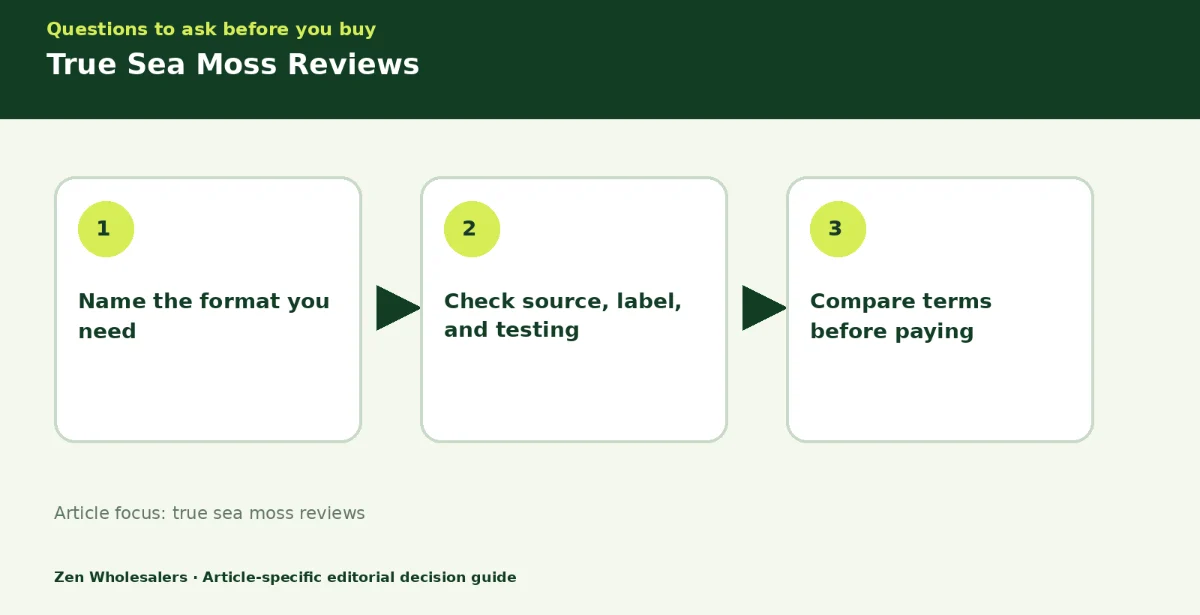
Step 1 — Look for specifics on the product page
- Species or common name of the seaweed.
- Harvest region or sourcing statement (be cautious of vague phrases like “wild-harvested” without detail).
- Product form (raw, dried, powder, gel, capsule).
- Preparation and storage instructions.
- Any stated lab tests or certificates. If a report is claimed, it should have a batch number, lab name, and date.
Step 2 — Cross-check reviews for consistency
- Do multiple reviewers describe the same texture, taste, or smell?
- Are there repeated complaints about mold, off-odor, or damaged packaging?
- Do customers report receiving lab info or batch numbers when they requested it?
- Are shipment timing issues consistent or one-off?
Step 3 — Ask the seller a short list of questions when in doubt
- Can you share the most recent third-party lab report for heavy metals and microbiology?
- What species of seaweed is in this product?
- Where and when was it harvested?
- How should I store this product once I open it?
H2: Common review signals and what they likely mean
H3: Positive signals in reviews
- Clear photos of the product and the gel or dried form.
- Descriptions that match the product page: same color, size, and smell.
- Multiple buyers noting the same steps for preparation.
H3: Warning signs in reviews
- Multiple reports of strong fishy or rotten smells after opening.
- Reports of skin reactions or stomach upset without follow-up from the seller.
- Claims that the product arrived moldy or with unusual residue.
- Reviews that are very short and only praise, with no product details—these can be less reliable.
H2: Forms of sea moss and what reviews tell you about each
Below is a simple comparison of common sea moss product forms. Reviews often highlight different pros and cons for each form. This table helps you weigh those pros and cons.
| Form | What reviews commonly praise | What reviews commonly complain about | What to check in reviews |
|---|---|---|---|
| Raw / Whole | Fresh feel; looks like natural sea moss; flexible | Needs cleaning; can have debris or smell if not processed well | Look for photos, prep tips, seller cleaning process |
| Dried | Long shelf life; easy to ship | Can be brittle or overly processed | Check how it rehydrates in reviews; photos of rehydrated product |
| Gel (prepared) | Ready to use; saves time | Shorter shelf life; can separate or get cloudy | Look for storage notes and photos; check if consistency is steady |
| Powder / Capsules | Easy dosing; no prep | May be mixed with fillers or lower potency | Check ingredient lists and any lab testing claims |
H2: A practical decision checklist — use this when reading “true sea moss reviews”
Use this checklist for any product you compare. Mark each item Yes/No/Ask Seller.
- Product form listed clearly (raw, dried, gel, powder).
- Seaweed species or common name stated.
- Harvest region or source stated (not just “ocean”).
- Batch number or production date available on request.
- Seller offers or links to third-party lab reports (heavy metals, microbiology).
- Clear storage and preparation instructions included.
- Reviews include clear photos of the actual product.
- Multiple reviews mention the same preparation experience.
- No repeated reports of mold, strong rot odor, or skin reactions.
- Seller responds to customer questions in reviews or on product page.
- Return policy or contact options provided.
If several items are No or Ask Seller, consider a different product or ask for lab documentation before buying.
H2: How to verify lab reports and test claims
- A legitimate lab report should list the lab name, test methods, date, and batch number.
- Third-party labs are external organizations that test products independently.
- If a seller posts a report, confirm the batch number on the product matches the report.
- Beware of vague statements like “tested for safety” with no document.
- If no tests are available, reviews alone cannot prove safety.
H2: Red flags in reviews and product listings
- No clear product photos or only stock images.
- Reviews that are all similar in wording and posted very close together.
- Sellers who refuse to answer basic sourcing and testing questions.
- Claims of dramatic health effects or disease cures in reviews or product text. These are not reliable or allowed claims.
H2: What to do if you find concerning reviews
- Contact the seller through their official contact channel and ask for details.
- Check the company’s response history. A good seller will reply clearly.
- If you suspect a safety issue after purchase, stop using the product and consult a healthcare professional.
- Use review date patterns to see whether a problem was isolated or ongoing.
H2: Practical buying flow — a short step-by-step
- Read the product page for species, form, and storage.
- Scan reviews for photos and repeated themes.
- Use the decision checklist above.
- Ask the seller for lab reports or batch info if unsure.
- Buy a small amount first to test preparation and tolerability.
- Keep the product label and batch number for reference.
H2: When to choose raw, dried, gel, or supplements
- Choose raw or dried if you plan to make your own gel and want full control of preparation.
- Choose pre-made gel for convenience and faster use. Check storage instructions closely.
- Choose powder or capsules if you prefer measured dosing and portability. Check ingredient lists for fillers.
- Reviews can show ease of use and consistency for each form, but cannot replace lab testing.
H2: How to evaluate “infinite age sea moss reviews” and similar specific searches
People often search specific brand names or phrases like “infinite age sea moss reviews.” The same rules apply:
- Look for photos, batch identifiers, and repeatable comments.
- Search for any posted lab reports tied to the brand and batch.
- Watch for overly positive or overly negative review clusters that lack detail.
- If a brand offers wholesale options or larger quantities, ask the same lab and sourcing questions before buying in bulk.
H2: A note on labeling and legal claims
- Sellers cannot make health claims that cure or prevent disease. If you see such claims, treat them as a red flag.
- Look for clear ingredient lists and avoid products with many vague additives.
Frequently asked questions
What should I check first?
Start with the product or ingredient label, the source information, and whether the seller can answer clear questions.
Is this a replacement for professional advice?
No. Use this article as general education. Ask a qualified professional for personal medical, legal, or food-safety guidance.
Where can I learn more?
Use the Zen Wholesalers Learning Library to compare related guides and choose a useful next question.
References
- [1] Harvard T.H. Chan School of Public Health, “Seaweed.” https://nutritionsource.hsph.harvard.edu/seaweed/
- [2] Smyth PPA. “Iodine, Seaweed, and the Thyroid.” European Thyroid Journal, 2021. https://pmc.ncbi.nlm.nih.gov/articles/PMC8077470/
- [3] Food Standards Australia New Zealand, “Survey of iodine levels in seaweed and seaweed containing products,” updated 2025. https://www.foodstandards.gov.au/science-data/monitoring-safety/surveyofiodinelevels
- [4] Operation Supplement Safety, “Sea Moss in Dietary Supplements.” https://www.opss.org/article/sea-moss-dietary-supplements
- [5] Blikra MJ et al. “Consequences of acute and long-term excessive iodine intake: A literature review focusing on seaweed as a potential dietary iodine source.” 2024. https://doi.org/10.1111/1541-4337.70037