

Short answer: There is no single place that always produces the “best” sea moss. Quality depends on the species, the local water and tidal conditions, how harvesters collect it, and how the product is handled and tested after harvest. If you want the best sea moss for your needs, check the source details, ask for testing, and match the product form to how you plan to use it.
Why I start with that short answer
- Many shoppers ask for one place or one country. That can be misleading.
- Sea moss is a plant that changes with its environment.
- The same coast can give great sea moss one week and weaker material another week.
- So the right next step is to know what to check and what questions to ask.
How to think about “best”: the main factors
When people say “best,” they often mean one or more of these things: clean water, known species, full traceability, safe processing, and consistent lab testing. Below are the main factors that affect sea moss quality.
Species and variety
Different algae are sold as “sea moss.” Common groups include Chondrus (Irish moss) and several tropical red algae like Gracilaria or Eucheuma. Each species looks different. Each has its own texture and how people use it in food or products. Which species is “best” depends on what you plan to do with the sea moss (e.g., make gel, cook, or dry for capsules).
Water and local environment
Sea moss absorbs minerals from the water where it grows. Clean water with low industrial pollution is important. Local runoff, algal blooms, and nearby shipping or mining can affect water quality. No origin guarantees “clean” water; good sellers test their product.
Harvesting methods
Hand-harvested sea moss tends to be gentler than machine-harvested. Low-impact harvests leave holdfasts and allow regrowth. Overharvesting or rough methods can damage the bed and lower future quality. Responsible harvest methods are part of “best.”
Freshness and processing
After harvest, how sea moss is rinsed, dried, and stored matters. Improper drying or long exposure to heat can change texture and color. Contamination can occur during processing if hygiene is poor. Sellers who quickly clean and dry sea moss and who keep it cool tend to preserve quality better.
Testing and transparency
A single origin is not proof of safety or quality. The most useful proof is testing done by trusted labs. Tests often include iodine levels, heavy metals, and microbial counts. Ask for recent lab reports and a clear chain of custody for the samples tested.
Variability and season
Sea moss composition shifts with seasons and tides. A batch harvested in winter may differ from one in summer. That is normal. Regular testing and batch numbering help buyers trace differences.
Common origins and what they mean
This table lists common origin regions, the species typically associated with them, and the things to check for each. This is a general guide. Any region can produce good or bad sea moss depending on local conditions and practices.
| Region / Typical source | Common species sold as “sea moss” | What to check from this region |
|---|---|---|
| North Atlantic coasts (e.g., Ireland, eastern Canada) | Chondrus crispus (Irish moss) and related red algae | Ask for species name, local water quality reports, and batch lab testing |
| Caribbean islands | Gracilaria spp., Eucheuma spp., and mixed red algae | Check harvest method, drying process, and lab tests for iodine and heavy metals |
| Tropical Pacific and Southeast Asia | Gracilaria, Eucheuma, other red algae | Ask about processing steps and third-party testing; check for clear origin labeling |
| Mixed coastal suppliers (varied regions) | Blends or generic “sea moss” | Request a full origin statement and test reports per batch |
Note: The table shows common patterns, not guarantees. Sellers that provide lab testing and clear harvest details give you more to evaluate.
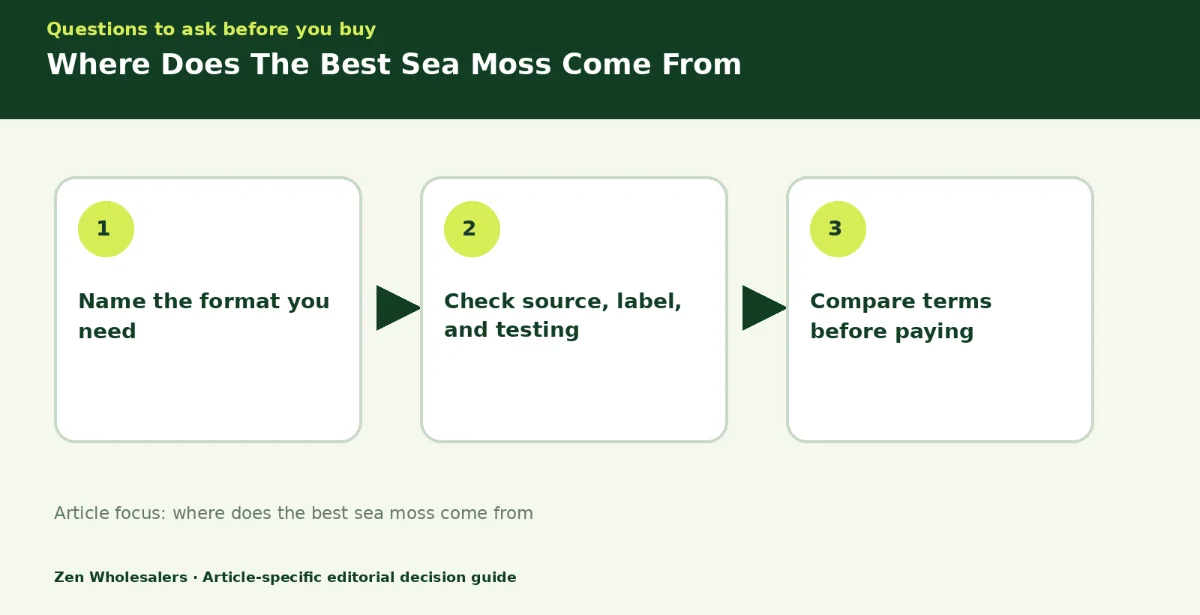
What to check before you buy: a practical checklist
Use this checklist when comparing products or suppliers. Ask suppliers to answer each item. If they won’t answer, consider it a red flag.
- Species name: Ask the seller for the scientific name or the best local name. Do not accept only “sea moss” with no detail.
- Exact origin: Where was it harvested? Which island, bay, or coast? A general country name is a start, but a specific location is better.
- Harvest date or batch number: Freshness and season matter. A batch number helps track lab results.
- Harvest method: Was it hand-harvested or mechanically harvested? What steps were taken to protect the bed?
- Processing steps: How was it rinsed and dried? Was any heat used? Was it freeze-dried?
- Storage and packaging: How was the product stored post-harvest? What packaging was used?
- Lab testing: Ask for recent third-party lab reports. Useful tests include:
- Heavy metals (lead, cadmium, mercury) — request limits and method used.
- Microbiology (total plate count, yeast, mold, coliforms).
- Iodine content — because iodine in seaweed can be high and variable. (See References [2], [3], [5].)
- Certificate of Analysis (CoA): Look for a dated CoA that matches the product batch.
- Chain of custody: Can the seller show how a tested sample matches the batch in your package?
- Sustainability assurances: Does the seller describe harvest limits, seasonal closures, or community management?
- Return policy and customer support: Can you return unopened product? Is there a contact for questions?
If a product checks most of these boxes, you have more reason to trust it. If many answers are missing, look elsewhere.
What tests matter and why
Testing does not make a product “best” on its own, but it is a critical proof point.
- Iodine: Seaweeds can contain high and variable iodine. High iodine intake can affect thyroid function in some people. If you have thyroid conditions, ask a health professional before regular use. Testing for iodine gives consumers useful information about safe serving sizes and product use (see [2], [5], and the survey overview in [3]).
- Heavy metals: Like many marine plants, sea moss can concentrate metals found in the water. Heavy metals testing helps confirm the product meets safety limits.
- Microbial testing: Proper drying and handling reduce microbial risks. Tests show whether processing and storage were hygienic.
- Identity testing: DNA or microscopic checks can confirm species identity when needed, though not all sellers provide this.
Caveat: Lab tests are only as good as the lab, sampling, and documentation. Prefer tests from accredited third-party labs with dates and batch IDs.
Buying formats and what to choose
Sea moss is sold in many forms. Each form has pros and cons. Pick the form that matches how you will use it.
- Raw dried moss
- Pros: Long shelf life when dry. You can rinse and prepare it your way.
- Cons: Requires rinsing and soaking. Quality depends on drying and storage.
- Best if: You want full control of preparation or make bulk gel.
- Sea moss gel (prepared)
- Pros: Ready to use. Convenient for smoothies and topicals.
- Cons: Shorter shelf life. Quality depends on how the gel was made and stored.
- Best if: You want convenience and immediate use.
- Capsules/powder
- Pros: Easy dosing, portable.
- Cons: Often concentrated or blended. Look for ingredient lists and testing.
- Best if: You want precise serving sizes and convenience.
- Whole wet sea moss (fresh)
- Pros: Minimal processing.
- Cons: Short shelf life and shipping constraints.
- Best if: You are local or buying in small, immediate-use amounts.
If you are buying wholesale, confirm how the seller stores and ships bulk lots. Ask about packing dates, batch testing, and shelf life under specified storage conditions.
A simple decision guide (table)
Use this short table to match buyer needs to questions to ask.
| Your need | Best format to consider | Key questions to ask |
|---|---|---|
| Long storage, DIY prep | Dried raw sea moss | Where was it harvested? How was it dried? Can you provide a CoA for the batch? |
| Quick, ready-to-use | Sea moss gel from a known maker | When was it made? How is it preserved? What is the use-by date? |
| Consistent dosing | Powder or capsules with CoA | Is the product standardized? Which tests were done? What is the serving size basis? |
| Buy in bulk for resale | Wholesale dried or bulk gel | Can you show batch CoAs and traceability? What are MOQ and storage instructions? |
What origin information cannot prove
Origin labels can be useful. But they do not prove everything.
- A country or island name does not prove water is free from contamination. Local pollution, storms, and runoff can change water quality quickly.
- A species name on a label does not guarantee identity unless the seller provides lab confirmation.
- A claim that sea moss is “wild” or “organic” means different things in different places. There may be no official organic standard for wild-harvested seaweed in some regions.
- Good lab reports on one batch do not automatically apply to another batch from the same supplier. Always ask for batch-linked reports.
Use the origin as one piece of the puzzle. The most useful proof is current batch testing and clear harvest and processing details.
Safety notes and iodine (what evidence says)
Seaweeds, including many sea moss types, can have variable iodine. In some cases, iodine levels are high enough to affect thyroid function in susceptible people. Reviews and surveys point to this variability and potential for excessive intake if someone eats large amounts of certain seaweeds regularly [2], [3], [5]. If you have thyroid concerns, speak with a medical professional before adding seaweed products to your regular diet.
Operation Supplement Safety also advises caution about sea moss dietary supplements and emphasizes testing and labeling [4]. For general background on seaweed as a food group and nutrient content, the Harvard School of Public Health provides a concise overview [1].
How to verify a supplier (practical steps)
- Get the product label and ask for a batch CoA. A CoA should have a date, the lab name, and batch ID.
- Verify the lab identity. Prefer accredited third-party labs.
- Ask for photos or documentation of the harvest site and processing facility.
- Ask whether the product was tested for iodine, heavy metals, and microbes. Request specific limits used.
- If buying wholesale, ask for a sampling plan and how often batch testing is done.
- If unsure, order a small test batch and have your own third-party lab test it before buying larger amounts.
Where to go next on this site
- Learn more about seaweed basics and safety on our Learn pages: /learn/
- Compare product formats and shop our current offerings at /shop/
- If you want bulk buying options, visit /wholesale/ for details on minimums and support.
- For quick questions or custom orders, contact our team: /contact/
- Explore our home page for company information and updates: /
Conclusion
There is no single origin that always produces the best sea moss. Instead, the best choice depends on species, local water quality, harvest method, processing, and — most importantly — batch testing and transparency. Use the checklist and decision guide in this article to compare sellers. Ask for specific origin details, batch lab reports, and processing steps. If you need help choosing a format or placing a wholesale order, visit our guides at /learn/, browse choices at /shop/, or reach out via /contact/. For wholesale needs, see /wholesale/ to start a conversation.
Continue reading
Frequently asked questions
Is there one place that always makes the best sea moss?
No. Quality varies with species, water, harvest method, and processing. The same place can give different results at different times. Look for transparent testing and sourcing.
Should I worry about iodine in sea moss?
Sea moss can contain variable iodine. Some people, especially those with thyroid conditions, should be cautious. Ask for iodine test results and consult a health professional if you have concerns [2], [5].
Can I trust “wild-harvested” on a label?
“Wild-harvested” describes how the seaweed was collected but does not guarantee safety or sustainability. Ask for harvest details, season, and testing that matches the batch you will buy.
What lab tests should I ask for?
Useful tests are iodine level, heavy metals (lead, cadmium, mercury), and microbial counts. Ask for recent third-party CoAs tied to the product batch.
How should I store dried sea moss?
Store dried sea moss in a cool, dry, airtight container away from direct sunlight. Follow any specific guidance from the seller. Proper storage helps preserve quality.
If I buy wholesale, how do I ensure consistent quality?
Require batch-linked CoAs, a stated sampling plan, clear supply-chain details, and a return or remediation policy. Start with a small trial order and test samples before scaling up.
References
- Harvard T.H. Chan School of Public Health, “Seaweed.” https://nutritionsource.hsph.harvard.edu/seaweed/
- Smyth PPA. “Iodine, Seaweed, and the Thyroid.” European Thyroid Journal, 2021. https://pmc.ncbi.nlm.nih.gov/articles/PMC8077470/
- Food Standards Australia New Zealand, “Survey of iodine levels in seaweed and seaweed containing products,” updated 2025. https://www.foodstandards.gov.au/science-data/monitoring-safety/surveyofiodinelevels
- Operation Supplement Safety, “Sea Moss in Dietary Supplements.” https://www.opss.org/article/sea-moss-dietary-supplements
- Blikra MJ et al. “Consequences of acute and long-term excessive iodine intake: A literature review focusing on seaweed as a potential dietary iodine source.” 2024. https://doi.org/10.1111/1541-4337.70037