
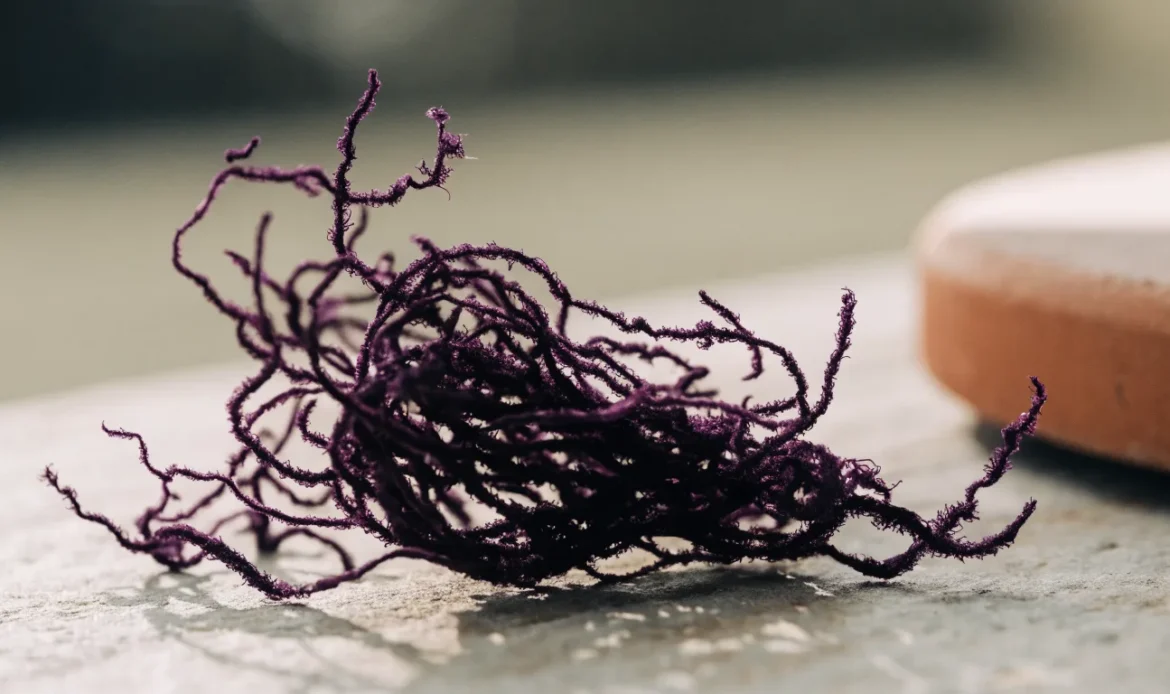
Short answer: Lila sea moss is a purple-tinged variety of edible seaweed sold in several formats (dried, gel, powder, capsule). The purple or “lila” color can come from the species, water conditions, or processing. Color alone does not prove safety, nutrient levels, or testing. Use the checklist below to compare products before you buy.
Why this quick answer matters: many shoppers see color and assume more minerals or safety. That is not reliable. This page tells you what to check, what you can’t learn just by looking, and how to pick a format that fits your needs.
What “lila sea moss” means
- “Lila” simply points to a purple or violet tone in the seaweed. Sellers use this term to describe color.
- The color can come from the seaweed species, the local growing environment, pigments, or the way it was dried and stored.
- Lila sea moss is not a single scientific species name. It is a market descriptor for appearance and sometimes for source.
What this does not mean
- The purple color does not prove the product is richer in any specific nutrient.
- Color does not prove the product has been tested for iodine, heavy metals, or microbes.
- You should treat the color as one factor among many when choosing a product.
Why color varies (simple explanations)
- Species: Different seaweed species naturally carry different pigments.
- Water and diet: Minerals and sunlight in the water can change pigment levels.
- Harvest time: Seasonal growth stages can affect color.
- Processing: Sun drying, oven drying, freezing, or blending into gel can alter color.
- Packaging: Oxidation and exposure to air can change the tone over time.
These causes mean color is a signal, not a certificate. If safety or nutrient content matters, look for testing and clear supplier information.
Common formats and how they change the product
Short list of common formats you will see for lila sea moss:
- Dried whole sea moss (loose or bundled)
- Raw-frozen sea moss
- Sea moss gel (reconstituted, refrigerated or frozen)
- Powdered or milled sea moss
- Capsules or tablets containing sea moss powders or extracts
Each format has trade-offs. Dried sea moss is easy to store and rehydrate. Gel is ready to use for recipes. Powder and capsules are convenient but change how you measure and use the product. Below are simple format notes to help decide.
Format notes (what to expect)
- Dried whole: Needs washing and soaking. Easier to inspect visually.
- Raw-frozen: May feel fresher but needs thawing and safe handling.
- Gel: Ready to add to food. Look for refrigeration instructions and short shelf-life once opened.
- Powder: Good for mixing into dry blends or capsules. Check for additives.
- Capsules: Easy dose form. Ask for the full ingredient list.
None of these formats guarantees testing or low iodine. Ask for lab results if that matters to you.
Safety and testing you should ask about
Seaweed can contain useful minerals. It can also contain high iodine or traces of metals, depending on location and species. Because levels vary, the safest path is to ask the supplier clear questions and look for documentation.
Questions to ask suppliers or look for on the label:
- What species is this product?
- Where was it harvested or farmed (region)?
- How was it processed (sun-dried, oven-dried, freeze-dried)?
- Is there a Certificate of Analysis (COA) or third-party lab report?
- Has the product been tested for iodine, heavy metals (lead, mercury, cadmium), and microbial contaminants?
- What is the recommended storage and use after opening?
- What is the lot or batch number in case of recall or follow-up?
Why these checks matter
- Iodine can be very high in some seaweeds. If you have thyroid concerns, you should check iodine data before regular use (see refs) [2][5].
- Lab testing for heavy metals and microbes reduces uncertainty about contamination.
- A COA from an independent lab is more useful than a seller statement alone.
Useful reference points
- Public health and food-safety groups note that iodine content in seaweed varies widely and can be large enough to affect intake (Smyth; Blikra) [2][5].
- General information on seaweed nutrition and variability is available from nutrition authorities (Harvard T.H. Chan) [1].
- Regulatory and monitoring agencies publish surveys and data on iodine in seaweed products (Food Standards Australia NZ) [3].
- Information about sea moss in dietary supplement markets and labeling is discussed by Operation Supplement Safety [4].
What labels and photos can (and cannot) prove
You can often use a product label and photos to confirm some details. But many important facts require documentation or conversation.
Things photos and labels can help confirm:
- Visible condition: signs of mold, obvious debris, or strange odors (a photo can show texture).
- Ingredients list: shows if other items or preservatives were added.
- Storage info: refrigeration recommendations and handling instructions.
- Manufacturer name and contact info.
Things photos and labels cannot prove:
- Actual iodine level per serving.
- Whether heavy metals or microbial testing was done.
- Whether the product is truly the species claimed.
- Exact origin if the label lists a broad region without traceability.
If a label shows a COA or a QR code linking to lab results, follow that link and read the report. If no lab report is available, ask the supplier.
Practical decision checklist for buying lila sea moss
Use this checklist to compare two or three products. Below is a compact decision table you can print or copy.
| Check | Why it matters | How to verify |
|---|---|---|
| Species name | Different species can have different composition | Look for Latin name on label or ask supplier |
| Harvest/farm region | Water quality and regulations vary by place | Ask for location; request harvest details |
| Format (dried, gel, powder) | Affects storage, handling, and use | Decide which format fits your cooking or production needs |
| Processing method | Affects color and microbial risk | Ask: sun-dried, oven-dried, freeze-dried, pasteurized |
| Certificate of Analysis (COA) | Shows testing for iodine, metals, microbes | Request COA; check lab name and date |
| Iodine testing result | Essential if you track iodine intake | Ask for specific iodine value per serving or per gram |
| Heavy metal testing | Protects against contamination | Check COA for lead, mercury, cadmium results |
| Microbial testing | Important for raw or gel products | Ask for tests for common food pathogens |
| Additives or fillers | May affect taste and use | Read full ingredient list |
| Shelf / storage guidance | Affects usability after purchase | Check label for refrigeration and best-by info |
| Traceability (lot number) | Helps with recalls or quality follow-up | Prefer products with lot numbers or trace codes |
| Supplier contact & responsiveness | Good support matters for questions | Email or call; note how fast and clear the reply is |
| Price per usable unit | Helps compare real cost across formats | Convert price to weight of usable product after prep |
How to use the table
- Give a simple score (yes / no / unknown) for each row when you compare products.
- Prioritize COA, iodine, and heavy-metal testing if you consume seaweed regularly.
How to prepare and store lila sea moss safely
Simple handling tips:
- Wash dried sea moss before soaking. Rinse until water runs clear.
- Soak dried sea moss in clean water for several hours, then rinse again.
- If using raw-frozen, thaw in the refrigerator and use within safe time limits.
- For gel, follow the seller’s storage directions. Keep refrigerated or frozen as recommended.
- For powdered or capsules, store in a cool, dry place as instructed.
Food safety reminders
- Use clean utensils and containers.
- Discard sea moss that smells off or shows visible mold.
- When gifting or selling prepared gel, provide clear date and storage instructions.
Choosing a format: a short decision guide
Which format is best depends on your use:
- Buy dried whole or raw-frozen if:
- You want to inspect the seaweed visually.
- You plan to rehydrate for recipes.
- You need a product with longer storage before opening.
- Buy gel if:
- You want convenience and a ready-to-use product.
- You plan to add it directly to smoothies or recipes.
- You accept shorter refrigerated shelf life once opened.
- Buy powder or capsules if:
- You need a measured or shelf-stable form for blending or supplements.
- You prefer to avoid preparation steps.
Always check the testing and COA regardless of format.
What information cannot be deduced from color or photos
Be direct about limits:
- Purple or lila hue cannot prove low or high iodine.
- Color cannot confirm absence of heavy metals or microbes.
- Attractive photos do not mean third-party testing was done.
If a seller highlights color as the main benefit, ask for supporting test results. If none are provided, treat the color as descriptive only.
Useful next questions to ask a seller
If you are considering a purchase, ask:
- Can you provide a COA for this lot showing iodine and heavy metal results?
- What species exactly is this product? (Please give Latin name.)
- Where was it harvested or farmed, and when?
- How was it processed and packaged?
- Do you have handling and shelf-life guidance for my chosen format?
Good suppliers will answer these clearly or point you to documentation.
Useful next guides and pages
- Learn more about sea moss basics: Sea moss learning hub
- Compare product formats and preparation tips: Formats & preparation
- Browse product options: Shop sea moss
- Interested in bulk buying? See: Wholesale information
- Questions or custom orders: Contact us
- Back to our main site: Home
Conclusion
Lila sea moss describes a purple-toned seaweed product. Color is a starting point, not proof of safety or content. The most useful next steps are simple: ask the seller for species, processing details, and a recent Certificate of Analysis that shows iodine and heavy-metal testing. Use the checklist above to compare options and pick the format that matches how you plan to use the product. If you need bulk or commercial options, follow the links above to wholesale or shop pages and ask for lot-based testing.
Frequently asked questions
Is lila sea moss a special species?
Not necessarily. “Lila” refers to color. It can come from several species or growing conditions. Ask the seller for the Latin name to know the species.
Does the purple color mean more minerals?
Color alone does not prove more minerals. Mineral and iodine levels vary by species and location. Ask for lab data if mineral content matters to you [1][2][5].
How much iodine is in sea moss?
Iodine levels vary widely by species and harvest location. You should ask for a specific iodine test result for the lot you plan to buy before relying on any number [2][3][5].
Can I trust a supplier’s statement without a COA?
A direct supplier statement is helpful but a COA from an independent lab gives clearer evidence. If you plan to consume sea moss often, request the COA and check the testing date and lab name.
Is sea moss gel safe to store at room temperature?
That depends on how it was made and preserved. Follow the seller’s storage instructions. Many prepared sea moss gels require refrigeration and have a short refrigerated shelf life once opened.
Where can I learn more about seaweed and nutrition safety?
Reliable sources include nutrition and public health pages that discuss variability and testing of seaweed products (for example, see Harvard T.H. Chan and regulatory survey data) [1][3].
References
- Harvard T.H. Chan School of Public Health, “Seaweed.” https://nutritionsource.hsph.harvard.edu/seaweed/
- Smyth PPA. “Iodine, Seaweed, and the Thyroid.” European Thyroid Journal, 2021. https://pmc.ncbi.nlm.nih.gov/articles/PMC8077470/
- Food Standards Australia New Zealand, “Survey of iodine levels in seaweed and seaweed containing products,” updated 2025. https://www.foodstandards.gov.au/science-data/monitoring-safety/surveyofiodinelevels
- Operation Supplement Safety, “Sea Moss in Dietary Supplements.” https://www.opss.org/article/sea-moss-dietary-supplements
- Blikra MJ et al. “Consequences of acute and long-term excessive iodine intake: A literature review focusing on seaweed as a potential dietary iodine source.” 2024. https://doi.org/10.1111/1541-4337.70037