

Short answer: Sea moss contains iodine and other minerals that can affect the thyroid. The evidence that sea moss fixes or treats hypothyroidism is limited. If you have hypothyroidism, check your iodine intake, ask your clinician about your thyroid tests, and review any sea moss product for iodine and testing information before you use it.
How sea moss might affect the thyroid — the basic idea
The thyroid needs iodine to make thyroid hormones. Foods with iodine can change how much hormone your body makes. Sea plants, including sea moss, often contain iodine. That means sea moss can raise your iodine intake, sometimes a lot. Too much or too little iodine may change thyroid function in some people. This is basic nutrition science, not proof that sea moss treats disease. [1][2]
Key points:
- Iodine is the nutrient the thyroid uses. If you already get a steady, recommended amount from food or supplements, adding more iodine from sea moss could change that balance. [1][2]
- Sea moss also contains other minerals and small amounts of nutrients, but their effect on the thyroid is less clear. [1]
What sea moss contains and why it matters
Sea moss is a general name for several types of red and green seaweeds used as food and supplements. The exact mix of minerals depends on the species, where it was grown, and how it was processed.
Common features:
- Iodine: Can range from low to very high depending on species and source. Some seaweeds are known to have especially high iodine. [3]
- Other minerals: Potassium, calcium, magnesium, and trace elements are often present. [1]
- Contaminants: Seaweed can pick up heavy metals or pollutants if it grows in contaminated waters. That is why source and testing matter. [3][5]
Because iodine and other components vary a lot by batch and species, one jar of sea moss can be very different from another jar.
What the evidence says about sea moss and hypothyroidism
It helps to separate three kinds of information:
- Food composition: Studies that measure what seaweed contains (iodine, minerals). These are lab analyses and are useful for understanding potential exposure. [1][3]
- Traditional or anecdotal use: People and cultures have used seaweed for food and health. That is historical but not clinical proof.
- Clinical proof: Controlled human studies that show whether sea moss improves or harms people with hypothyroidism. As of now, there is little to no strong clinical evidence showing sea moss cures or reliably treats hypothyroidism. We do have evidence that excessive iodine intake from seaweed can cause or worsen thyroid problems in some people. [2][5]
Put simply: we know sea moss can supply iodine. We do not have enough clinical trials showing sea moss reliably helps people with hypothyroidism. We also have evidence that too much iodine can cause thyroid problems. [2][5]
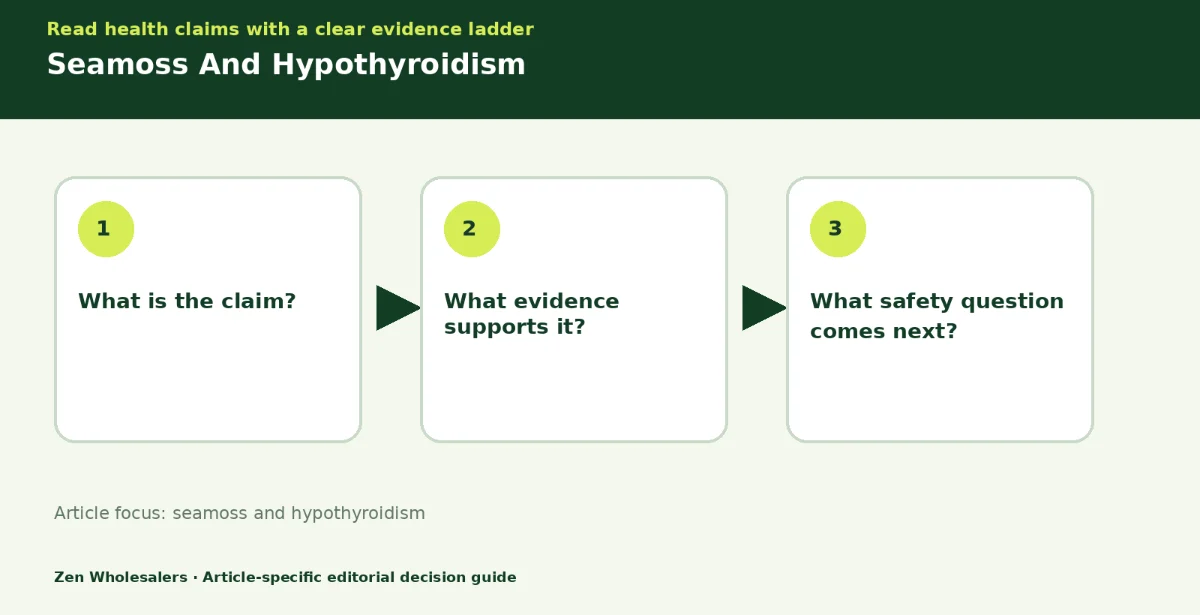
Evidence strength ladder — how to read claims
This short ladder shows how strong different kinds of claims are:
- High strength: Measured nutrient levels in seaweed (lab data). These tell you what’s in the plant. [3]
- Medium strength: Documented effects of iodine on thyroid health from nutrition and clinical endocrinology literature. These explain how iodine affects thyroid function. [2][5]
- Low strength: Claims that a specific sea moss product will improve hypothyroidism without clinical trials. These need controlled human studies to be proven.
If someone says “sea moss will fix your thyroid,” that is a low-strength claim unless backed by clinical trials.
Risks: what can go wrong
- Excess iodine
- Eating seaweed with very high iodine can trigger thyroid issues in some people. Too much iodine has been documented to cause both underactive and overactive thyroid in susceptible people. [2][5]
- Variable iodine levels
- Different seaweeds and products contain different iodine amounts. Labels often do not list iodine content, so consumers may not know how much they are getting. [3]
- Interaction with thyroid medicines
- Changes in iodine intake can alter thyroid hormone levels. If you take thyroid medication, unplanned changes in iodine could affect your labs or symptoms. Speak to your clinician before adding iodine-rich foods or supplements. [2][5]
- Contaminants and inconsistent testing
- Some seaweed products are not tested for heavy metals, microbes, or iodine content. That adds risk, especially for regular or high intake. [3][5]
These risks are not hypothetical. Research shows that excessive iodine intake from seaweed can have real effects on thyroid health in some groups. [2][5]
Safety and when to ask a clinician
Talk to your clinician if any of these apply to you:
- You have diagnosed hypothyroidism or hyperthyroidism.
- You take thyroid medication (levothyroxine or others).
- You are pregnant, breastfeeding, or planning pregnancy.
- You have heart disease or kidney disease.
- You have symptoms that could be thyroid-related: tiredness, weight changes, hair loss, or changes in heart rate.
What to ask your clinician:
- How much iodine is appropriate for you given your current thyroid status and medication.
- Whether you should check thyroid labs (for example, TSH and free T4) before and after changing iodine intake.
- If a specific sea moss product is appropriate, given your labs and medications.
These conversations are important because small changes in iodine intake can change lab tests and symptoms for some people. [2][5]
Practical decision checklist: should you use sea moss if you have hypothyroidism?
Use this checklist before you start or continue sea moss.
- [ ] Do you have a formal diagnosis of hypothyroidism? If yes, talk to your clinician first.
- [ ] Are you taking thyroid medication? If yes, get clinician approval before adding sea moss.
- [ ] Have you had recent thyroid tests (TSH, free T4) in the last 6–12 months? If not, consider testing before making diet changes.
- [ ] Does the product list iodine content or independent lab testing? If no, be cautious.
- [ ] Is the sea moss from a known, reputable source with clear origin and testing? Prefer products with lab reports.
- [ ] Will you monitor thyroid tests after starting sea moss? Plan to recheck with your clinician.
- [ ] Are you pregnant, breastfeeding, or planning pregnancy? If yes, speak with your clinician before using sea moss.
- [ ] Do you have kidney disease or heart disease? If yes, check with your clinician first.
This checklist helps you decide and plan. It does not replace medical advice.
How to choose safer sea moss products
Look for:
- Clear origin: Where was it harvested? Wild or farmed?
- Lab testing: Third-party testing for iodine content, heavy metals, and microbial safety.
- Transparent labels: Ingredients, processing methods, and preservation steps.
- Reputable sellers: Sellers that provide test results or will answer questions about sourcing.
Be cautious with:
- Products that make strong health claims about curing or treating thyroid disease.
- Products with no testing information or vague origin statements.
Remember: a safer product reduces some risks, but it cannot guarantee safety for everyone. Even tested sea moss can still change iodine intake, so follow the checklist and your clinician’s advice. [3][5]
What we still do not know
- Whether regular use of sea moss improves symptoms or thyroid function in people with hypothyroidism. There are no robust human clinical trials proving this.
- Exact iodine exposure for many sea moss products on the market. Lab surveys show wide variation, but many products do not disclose iodine content. [3]
- How other nutrients in sea moss might interact with thyroid health over the long term.
Because of these gaps, the safest path is careful monitoring and clinician involvement for people with thyroid conditions.
Next practical steps
If you are thinking about trying sea moss:
- Read the product label and ask the seller about iodine testing and source.
- Talk to your clinician about your thyroid status and whether you should try sea moss.
- If your clinician approves, plan to retest thyroid labs after starting sea moss to see if levels change.
- If you notice symptoms (rapid heartbeat, unusual tiredness, weight shifts, hair loss), stop and talk to your clinician.
Want to learn more about sea moss basics? Visit our learning hub at Sea moss learning hub (/learn/). Looking for products with clear sourcing? Browse our selection at Shop sea moss (/shop/). If you are a business buyer, see our Wholesale options (/wholesale/). For questions, reach out at Contact us (/contact/) or return to our Home page (/).
Conclusion
Sea moss is a food that can contain useful minerals, including iodine. That same iodine can affect the thyroid. There is not enough clinical evidence to say sea moss treats hypothyroidism. If you have thyroid disease or take thyroid medicine, discuss sea moss with your clinician, check product testing and iodine content, and monitor thyroid labs if you start using it. Use the checklist above to help make a safer choice.
Useful next reads and actions: learn more about sea moss basics at our learning hub (/learn/), view tested products at shop (/shop/), or contact us directly at contact (/contact/) for sourcing questions. If you buy in bulk, see our wholesale (/wholesale/) page.
Frequently asked questions
Can sea moss cure hypothyroidism?
No clinical evidence shows that sea moss cures hypothyroidism. Sea moss can supply iodine, which affects thyroid function, but that is not the same as proving a treatment works. Clinical trials are needed. [2][5]
Is sea moss safe for people on thyroid medication?
It can be risky without medical supervision. Changes in iodine intake can alter thyroid lab results and interact with medication. Speak to your clinician before adding sea moss. [2]
How much iodine is in sea moss?
Iodine content varies widely by species, harvest site, and processing. Some seaweeds are low in iodine, others are very high. Product testing is the only reliable way to know the iodine amount in a specific product. [3]
Will eating small amounts of sea moss cause problems?
Some people can eat small amounts without issue. Others, especially those with thyroid disease or on thyroid medicine, may be affected even at low additional iodine intake. If you have thyroid concerns, consult your clinician. [2][5]
How can I reduce risk if I want to try sea moss?
Choose products with third-party testing, clear origin information, and labeled iodine content if available. Talk with your clinician and plan to monitor your thyroid labs. [3][5]
References
- [1] Harvard T.H. Chan School of Public Health, “Seaweed.” https://nutritionsource.hsph.harvard.edu/seaweed/
- [2] Smyth PPA. “Iodine, Seaweed, and the Thyroid.” European Thyroid Journal, 2021. https://pmc.ncbi.nlm.nih.gov/articles/PMC8077470/
- [3] Food Standards Australia New Zealand, “Survey of iodine levels in seaweed and seaweed containing products,” updated 2025. https://www.foodstandards.gov.au/science-data/monitoring-safety/surveyofiodinelevels
- [5] Blikra MJ et al. “Consequences of acute and long-term excessive iodine intake: A literature review focusing on seaweed as a potential dietary iodine source.” 2024. https://doi.org/10.1111/1541-4337.70037