
Short answer: Sea moss is a food source of minerals and fiber that could support heart-healthy eating. But good clinical proof that sea moss alone prevents heart disease is limited. Know what is known, what is uncertain, and what to check before trying supplements or new products.
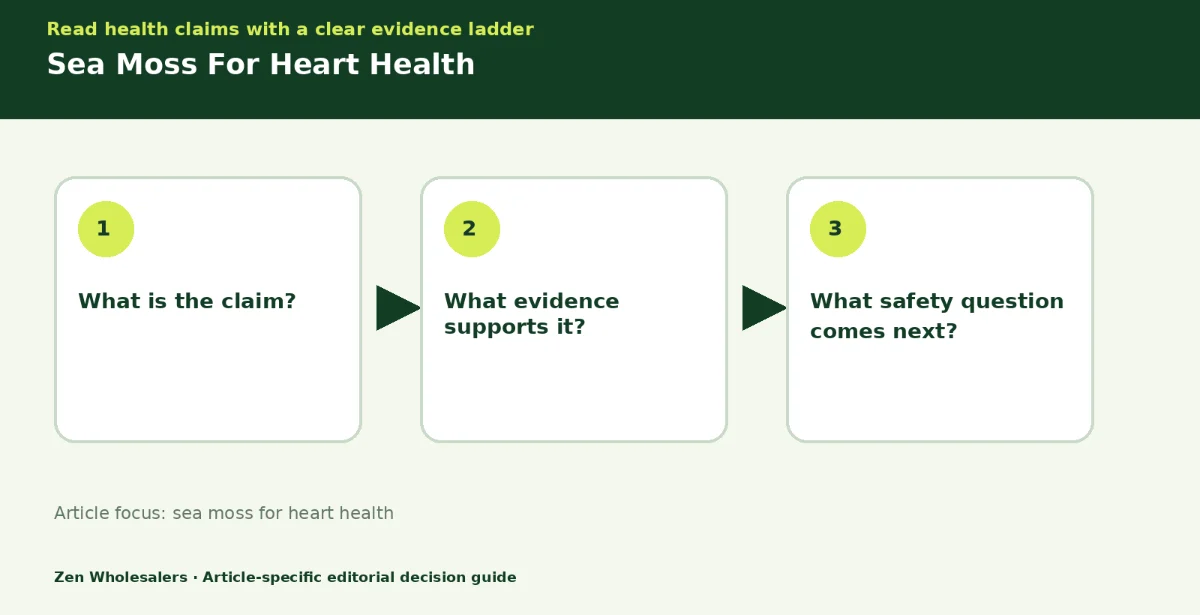
What this article covers (quick)
- What sea moss is and what it contains.
- What the science says about heart-related effects.
- How traditional use and early research differ from clinical proof.
- Safety, iodine concerns, and product checks.
- A short decision checklist to help you decide next steps.
What is sea moss?
Sea moss (often called seaweed or red algae in markets) is a group of edible marine plants. People have eaten many types of seaweed for centuries. It is used whole as food, in soups, or as a processed powder or gel. Seaweed provides minerals, some fiber, and other plant compounds. These nutrients are the reason people say sea moss could help health. [1]
What nutrients in sea moss relate to heart health?
Sea moss contains several nutrients that matter for the heart:
- Minerals such as potassium, magnesium, and calcium. These help with normal heart rhythm and blood pressure control. [1]
- Soluble fiber and polysaccharides. Fiber can help lower blood cholesterol when eaten as part of a diet. [1]
- Small amounts of other minerals and trace elements. These may support general nutrition. [1]
These food components are useful when they are part of a balanced diet. That does not mean eating sea moss by itself will prevent heart disease.
What the research says about sea moss and heart health
Short summary: most human evidence is indirect and limited. Some lab and animal studies suggest seaweed compounds could affect cholesterol, blood pressure, or inflammation. But high-quality clinical trials in people are few. Large, long human studies that prove sea moss prevents heart attacks or stroke do not exist right now.
What the studies show in general:
- Lab and animal studies: Certain seaweed compounds can lower cholesterol or relax blood vessels in animal models. These are early signals, not proof for people.
- Small human studies: Some trials of seaweed extracts or diets that include seaweed report modest improvements in cholesterol or blood pressure. These studies are often small, short, or use different seaweed types and doses.
- Overall certainty: Low to moderate. Results vary by seaweed type, processing, and study design. More large, well-controlled human trials are needed before we can say sea moss clearly improves heart outcomes in people.
Because the evidence is limited, sea moss should be viewed as a food that can fit into a heart-healthy diet—not as a solitary treatment for heart disease.
How sea moss might help heart risk factors
Here are plausible ways sea moss could support heart health, and how strong each idea is:
- Mineral balance (potassium, magnesium): These minerals help regulate blood pressure and heart rhythm. Eating potassium-rich foods is part of heart health advice. Seaweed is a source of minerals, so it may contribute to this benefit when used as food. [1]
- Soluble fiber and polysaccharides: Soluble fiber can trap bile acids and help lower LDL (“bad”) cholesterol over time. Some seaweed contains soluble polysaccharides that act like fiber. This offers a credible route for cholesterol effects, but the size of any effect depends on how much and what type of seaweed is eaten. [1]
- Antioxidant and anti-inflammatory compounds: Seaweed has plant compounds that reduce oxidative stress in lab studies. Reduced inflammation could support heart health indirectly. Human evidence is limited and mixed.
- Weight and blood sugar control: Seaweed can be low in calories and contain fiber. As part of a balanced diet, it may help with weight and blood sugar control. These are indirect ways to support the heart.
Keep in mind: these mechanisms are plausible. They do not equal proof that sea moss reduces heart attacks or strokes in people.
Food tradition vs clinical proof
People in parts of Asia and the Caribbean have used seaweed in food and medicine for generations. Traditional use provides useful clues about safety and ways to prepare seaweed. It also shows that seaweed can be a regular part of a healthy diet for many people.
But tradition is not the same as clinical proof. Traditional use suggests seaweed is often safe when prepared as food. Still, clinical trials are needed to quantify benefits and risks for specific conditions like heart disease.
Sea moss as whole food vs processed supplements
There are two common ways people use sea moss:
- As a food ingredient (raw or cooked seaweed, gels, whole dried seaweed).
- As a processed supplement (capsules, powders, extracts, combined blends).
Whole foods are easier to evaluate because the nutrient content is more consistent. Processed supplements can have big variations. They may be concentrated, mixed with other ingredients, or contain more iodine than a regular food serving. Paper and lab analyses have found that iodine and other minerals in seaweed products can range widely. This makes product checks important. [4]
Iodine—why it matters
Seaweed can contain high levels of iodine. Iodine is essential for thyroid function. But too much iodine can cause thyroid problems in some people. People with thyroid disease, pregnant people, and those on certain medications should be cautious. Several reviews highlight the risk of excess iodine from seaweed and seaweed products. [2][5]
If a product lists iodine content on the label, that helps you estimate exposure. If it does not, the content can be unpredictable. For safety, check labels and ask the seller about iodine testing and limits.
Safety and when to ask a clinician
Sea moss is generally safe as a food for many people. But there are important cautions.
Ask a clinician before using concentrated sea moss supplements if any of these apply:
- You have thyroid disease or take thyroid medications. High iodine may cause harm. [2][5]
- You take blood thinners, blood pressure drugs, diuretics, or other heart medicines. Seaweed minerals could interact with some drugs.
- You are pregnant, breast-feeding, or trying to become pregnant. Your iodine needs and risks change, and you should get personalized advice.
- You have kidney disease. Extra minerals can affect kidney function.
- You plan to use a high-dose extract or take sea moss as a daily supplement. Product doses can vary widely.
If you choose to eat sea moss as a food, prefer culinary portions and use it as part of a balanced diet. If you consider supplements, discuss them with your clinician and ask about lab monitoring if needed.
Citations supporting iodine and supplement variability: [2][4][5]
How to check sea moss products and sellers
When you consider a sea moss product, check these facts before buying. This decision checklist helps you weigh benefits and risks.
Product checklist (decision guide)
- Source and species: Does the seller list the seaweed species and country of origin?
- Food or supplement: Is it sold as a food ingredient or a dietary supplement?
- Ingredient list: Is it pure seaweed, or are other ingredients and additives included?
- Iodine content: Is iodine listed on the label, or can the seller provide testing results?
- Lab testing and Certificates of Analysis (CoA): Does the seller provide third-party testing for heavy metals, microbes, and contaminants?
- Processing method: Is it dried, powdered, extracted, or blended? Processing changes nutrient concentration.
- Serving size and recommended use: Does the package explain how to use it as food?
- Seller transparency: Can you contact the seller with questions? Is contact information and a return policy available?
If the product lacks answers for several of these, treat it with caution—especially if you have medical conditions.
Practical use ideas (food-first)
These simple, food-focused ideas let you get seaweed nutrients without relying on high-dose supplements:
- Add small amounts of dried or rehydrated seaweed to soups or stews.
- Mix powdered seaweed into salad dressings or smoothies sparingly.
- Use seaweed as a flavor booster in place of excess salt.
- Combine seaweed with beans, whole grains, and vegetables for balanced meals.
Food amounts are safer than concentrated extracts for most people. Keep portions modest until you know how your body reacts.
When evidence is strongest — and when it is weakest
- Stronger evidence: Seaweed is a source of minerals and fiber. These nutrients are known to support heart health when part of a balanced diet. [1]
- Weaker evidence: Direct proof that sea moss supplements reduce heart disease events (heart attack, stroke) in humans. Large clinical trials are lacking.
- Uncertain: The effect size, best species or preparation, and long-term safety of concentrated sea moss supplements in diverse populations.
Be cautious when sellers claim specific heart benefits without human trial data.
Checklist: Quick action steps if you want to try sea moss
- Read the product label for species, origin, iodine, and testing details.
- Prefer products with third-party testing or clear food-grade labeling.
- Start with food forms and small portions before moving to concentrated products.
- Tell your clinician if you plan to start daily seaweed supplements—especially if you have thyroid or heart conditions.
- Monitor symptoms and lab results if your clinician advises testing (thyroid tests, medication levels, electrolytes).
Common concerns and how to check them
- Contamination: Ask for testing for heavy metals and microbes. Some seaweed can absorb metals from water. [4]
- Iodine overload: If the product does not list iodine, contact the seller. People with thyroid issues should be careful. [2][5]
- Drug interactions: Bring the product label to your clinician or pharmacist to check interactions.
- Overuse: Avoid assuming more is better. Concentrated extracts can deliver high mineral doses that have risks.
Next questions to ask (if you want to learn more)
- What species and origin does this sea moss come from?
- Has the product been tested for iodine, heavy metals, and microbes?
- How does this product compare to other dietary sources of potassium and fiber?
- Can my clinician monitor any labs if I start a seaweed supplement?
Conclusion
Sea moss is a nutrient-containing food that can fit into a heart-healthy diet. It provides minerals and fiber that are useful for heart risk factors. But evidence that sea moss supplements by themselves prevent heart disease in people is limited. Be cautious with concentrated products, check labels, and ask a clinician if you have thyroid disease or take heart medications. Use sea moss as one part of a balanced diet and lifestyle that are proven to support heart health.
Explore more about seaweed and wellness on our site:
- Home: /
- Learn more about benefits: /learn/benefits/
- Read other guides: /learn/
- Shop our selection: /shop/
- Contact us with questions: /contact/
Continue reading
Frequently asked questions
Can sea moss lower my blood pressure?
Sea moss contains minerals like potassium and magnesium that support normal blood pressure. As food, it can be part of a heart-healthy diet. But no strong proof shows sea moss alone will lower blood pressure in every person.
Is sea moss safe for people with thyroid problems?
Not always. Seaweed can contain high iodine, which affects the thyroid. People with thyroid conditions should talk with their clinician before using sea moss products. [2][5]
Are sea moss supplements regulated?
Dietary supplements are not regulated like medicines. Quality and content can vary. Look for products with third-party testing or clear labeling. [4]
How much sea moss should I eat for heart benefits?
This article does not give doses. Heart benefits depend on overall diet and lifestyle. If you want specific guidance, ask your clinician or a registered dietitian.
Can pregnant people eat sea moss?
Pregnancy changes iodine needs and risks. Pregnant and breastfeeding people should check with their clinician before using seaweed supplements or high-iodine products.
What tests should I ask from my doctor if I start using sea moss regularly?
Discuss this with your clinician. They may suggest thyroid tests or monitoring if you have thyroid risk. They will decide what is appropriate for you.
References
- [1] Harvard T.H. Chan School of Public Health, “Seaweed.” https://nutritionsource.hsph.harvard.edu/seaweed/
- [2] Smyth PPA. “Iodine, Seaweed, and the Thyroid.” European Thyroid Journal, 2021. https://pmc.ncbi.nlm.nih.gov/articles/PMC8077470/
- [4] Operation Supplement Safety, “Sea Moss in Dietary Supplements.” https://www.opss.org/article/sea-moss-dietary-supplements
- [5] Blikra MJ et al. “Consequences of acute and long-term excessive iodine intake: A literature review focusing on seaweed as a potential dietary iodine source.” 2024. https://doi.org/10.1111/1541-4337.70037