
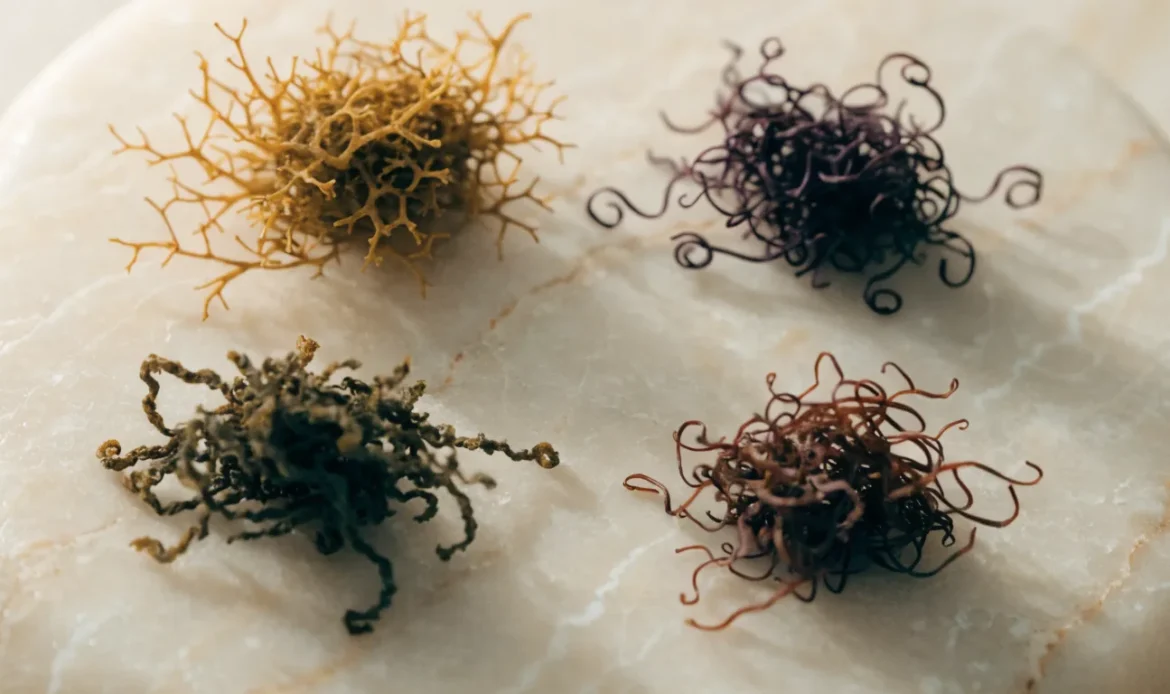
Short answer first: A picture of sea moss shows the seaweed’s visible traits — color, shape, texture, and how it is presented (wet, dried, powdered, or gel). Look at those traits to learn what form you are seeing. A picture alone cannot prove source, lab tests, or safety. Use the image to ask the right follow-up questions before buying or using sea moss.
Why this matters: many people first learn about sea moss from photos. Good photos can help you tell whether a product is raw, processed, cleaned, or packaged. But photos are only one piece of information. This guide explains what to look for in pictures of sea moss, how to compare image types, and a practical checklist you can use when deciding what to do next.
What exactly is a “picture of sea moss”?
A “picture of sea moss” can mean many things:
- A photo of raw seaweed strands pulled from water.
- A photo of dried sea moss, packed or loose.
- A product picture of sea moss gel in a jar.
- A close-up of powdered sea moss in a scoop or capsule.
- Lifestyle photos that show smoothies, food, or people holding the product.
All these pictures show different forms. Each form has different visual clues. Knowing these clues helps you understand what the seller or source is showing — and what they are not showing.
Common forms shown in pictures of sea moss
H3 Raw or fresh sea moss
- Looks like wet strands that may be limp or slightly firm.
- Colors vary from green to brown to red, depending on species and conditions.
- Photos may show sea moss on rocks, in buckets, or with water droplets.
H3 Dried sea moss
- Looks shriveled, lighter in weight, and often paler than wet moss.
- Strands may be curly or stiff.
- Dried photos may show bundled pieces or loose flakes.
H3 Sea moss gel
- Looks like a translucent, soft spread in jars.
- Texture is smooth and often glossy.
- Photos may show scoops or jars with labels.
H3 Powdered or capsules
- Powder photos show a fine, dry powder in spoons or piles.
- Capsule photos show pills on a dish or in a bottle.
H3 Blended or prepared products
- Photos of smoothies, desserts, or other foods show sea moss already mixed.
- These images hide the original form and make it hard to judge raw quality.
What a picture can show reliably
A good picture can help you check:
- Visible color and texture.
- Presence of obvious dirt, sand, or encrustations.
- Whether the product is wet or dry.
- Packaging style (jar, bag, bulk).
- Label presence and visible text (but not lab results).
- Scale or size, if a reference object (ruler, coin, hand) is shown.
What a picture cannot prove:
- Lab test results for contaminants or nutrient levels.
- Exact species or precise origin.
- Whether cleaning or processing removed risks.
- Shelf life or storage conditions behind the scene.
If you see a nice photo, ask for more details rather than assuming safety or quality.
Key visual clues to check in pictures of sea moss
H3 Color and hue
- Color tells you about how the moss looks at the time the photo was taken.
- Sea moss color can change with drying, lighting, and camera settings.
- Color alone cannot prove species or nutrient levels.
H3 Texture and strand shape
- Long, full strands in a photo usually show less processing.
- Broken fragments or a powder look show more processing.
- Gel photos show final texture but hide original strands.
H3 Surface debris
- Sand, small stones, or marine growths can sometimes appear in raw photos.
- Presence of debris in a product photo may indicate incomplete cleaning.
- If you see debris, ask how the product was cleaned.
H3 Scale and size references
- A hand, coin, or ruler in the photo gives a sense of size.
- Without scale, strand size and bundle weight are guesses.
H3 Packaging and labeling
- Photos that show a full label let you read ingredient lists or storage advice.
- Labels are helpful but do not replace lab certificates or tests.
How pictures of sea moss vary by purpose
- Marketing images: styled, well-lit, and may not be literal. Expect selective framing.
- Product packshots: white background, clear view of package and label. Useful for reading labels.
- Raw-harvest photos: show natural setting. Useful to see appearance but not cleanliness.
- Instructional photos: show how to prepare or store sea moss. Good for learning, not for buying.
Always ask for close-ups and packshot images if you need clearer facts.
Practical decision checklist: What to ask or check after you see a picture
Use this checklist when you find a picture you like. Check each item. If the picture fails to answer, ask the seller or source.
| Question to ask | Why it matters | If the picture doesn’t show it |
|---|---|---|
| Is the photo of raw, dried, gel, or powdered form? | Different forms mean different uses and handling. | Ask the seller to confirm the form. |
| Is there a clear shot of the label? | The label can list ingredients and storage. | Request a high-resolution packshot. |
| Is scale shown (hand, coin, ruler)? | Size helps estimate portion or strand length. | Ask for a photo with a familiar object. |
| Are there any visible debris, sand, or growths? | Debris may mean more cleaning is needed. | Ask how the product was cleaned and request cleaned images. |
| Is the product shown in natural light? | Lighting affects color accuracy. | Ask for unedited photos under daylight. |
| Is there a close-up that shows texture? | Texture indicates processing level. | Request a macro shot. |
| Does the seller provide lab testing or certificates? | Photos can’t show lab results. | Ask for testing documents or safety info. |
| Is production or harvest location listed? | Location affects shipping and regulations. | Request origin details; verify claims with documentation. |
| Is the product labeled for food use or supplement use? | Use classification affects handling and claims. | Confirm intended use and ask about packaging compliance. |
| Is storage advice shown? | Storage impacts shelf life and safety. | Ask how the product should be stored on arrival. |
This checklist focuses on what you can verify visually and what you should follow up on.
Decision guide: Which image type is best for your need?
Use this short guide to pick the right image type for your goal.
- You want to inspect raw quality: ask for raw-dry and raw-wet close-ups, plus scale.
- You plan to prepare food or gel: ask for finished gel photos and a prep step photo.
- You need a shelf-stable product: ask for clear packshots, ingredient list, and storage info.
- You want a powdered supplement: request capsule photos and a label that lists dosage and intended use.
- You need proof of safety: ask for lab test results; photos alone are not enough.
How to read photo claims and avoid common image pitfalls
- Watch for heavy photo editing. Saturation and filters change color.
- Beware staged lifestyle shots. These show mood, not product specifics.
- Check for missing context. If a photo shows a tiny jar, check the net weight in the label, if visible.
- Don’t assume harvest method from a picture alone. Words like “wild” or “hand-harvested” in a photo caption are claims you should verify.
- Ask for multiple angles: top-down, side view, close-up, and label shot.
How to take better pictures of sea moss (if you are a seller or documenter)
H3 Basic setup
- Use natural daylight or a soft white light. Avoid colored bulbs.
- Place the product on a neutral background (white, gray).
- Include a familiar object for scale (coin, ruler, hand).
H3 Camera tips
- Use a macro or close-up setting for texture shots.
- Reduce glare for gel photos by shooting from slightly above.
- Take multiple images: whole product, full packaging, close-up of texture, label.
H3 File and editing tips
- Save high-resolution files for detail.
- Use minimal editing. Fix straightening and mild exposure only.
- Keep an unedited original file if you need to prove authenticity.
Practical next steps after you review pictures
- Use the checklist above. Note missing items.
- Ask the seller for additional photos or documentation.
- If you plan to eat or sell the product, ask for testing or safety information. Photos cannot replace lab data.
- Compare multiple sellers’ images using the same criteria.
- If you photograph sea moss yourself, follow the camera tips and include scale.
Where to go next
- If you want general learning resources, visit our learn hub: /learn/.
- If you want to see product packshots and forms we offer, view /shop/.
- For bulk orders or wholesale images, visit /wholesale/.
- To ask specific questions or request extra images, contact our team: /contact/.
- Return to our home page for navigation and other guides: /.
Conclusion
A picture of sea moss is useful. It shows color, texture, and how a product is presented. But a photo has limits. It cannot prove safety, lab test results, or exact origin. Use pictures to guide follow-up questions. Use the checklist and decision guide here to pick the right next step. Ask sellers for labels, close-ups, scale, and any available safety documents before you buy or use sea moss.
Continue reading
Frequently asked questions
Can I tell species from a picture of sea moss?
Not reliably. Photos can hint at differences, but species ID usually needs a trained eye or lab work. Use photos as a starting point, not a final answer.
Do pictures show if sea moss is safe to eat?
No. A picture can show visible dirt or mold but cannot prove absence of microbes, heavy metals, or excess iodine. Ask for lab tests or safety statements for food use. (See sources on iodine and seaweed risks.) [1][2][4]
Are color differences in photos meaningful?
Color gives clues about wetness, drying, and camera settings. Lighting and editing change color. Use neutral-light photos for better comparison.
What should I do if a product image looks “too good”?
Request unedited photos, packshots showing labels, and any available testing documents. A very polished image may be a marketing shot rather than a literal view.
Can images be used to estimate quantity?
Only if the image includes a reliable scale reference like a ruler or a common object. Otherwise, quantity is best verified by weight or net volume shown on the label.
Where can I learn more about safety concerns related to seaweed products?
Public health and nutrition resources cover seaweed’s iodine content and safety considerations. For background, consult trusted sources listed in the References section. [1][2][3][5]
References
- Harvard T.H. Chan School of Public Health, “Seaweed.” https://nutritionsource.hsph.harvard.edu/seaweed/
- Smyth PPA. “Iodine, Seaweed, and the Thyroid.” European Thyroid Journal, 2021. https://pmc.ncbi.nlm.nih.gov/articles/PMC8077470/
- Food Standards Australia New Zealand, “Survey of iodine levels in seaweed and seaweed containing products,” updated 2025. https://www.foodstandards.gov.au/science-data/monitoring-safety/surveyofiodinelevels
- Operation Supplement Safety, “Sea Moss in Dietary Supplements.” https://www.opss.org/article/sea-moss-dietary-supplements
- Blikra MJ et al. “Consequences of acute and long-term excessive iodine intake: A literature review focusing on seaweed as a potential dietary iodine source.” 2024. https://doi.org/10.1111/1541-4337.70037